

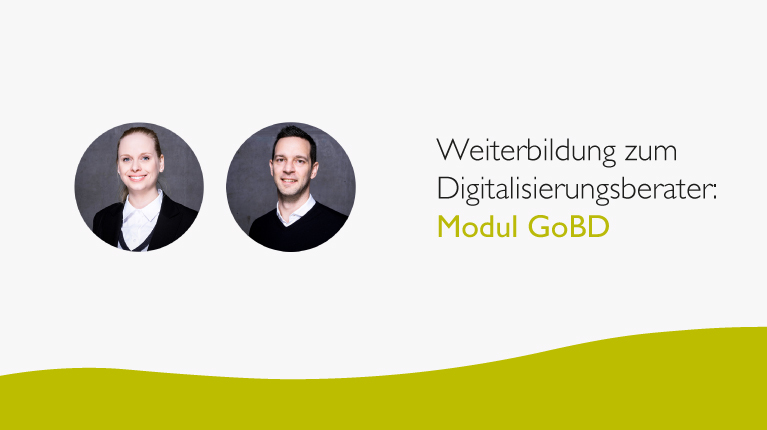

Simple bookkeeping is a thing of the past. Today, more and more tax firms are offering more comprehensive advice on Process optimisation and digitalisation … Anyone wishing to successfully navigate this important turning point will find the ‘Digitalisation Consultant’ further training course the ideal starting point. Designed by external experts, this course from the hsp academy offers a combination of exciting modules. One of the practical, cutting-edge modules covers the topic of GoBD – featuring two absolutely top-class lecturers.
On the Friday talk show „hsp live at 11“, presenter Paul Liese, Managing Director of hsp-Software, welcomed Carola Zimbrich and Raphael Kammer from WEFORM Consulting GmbH. Through their consultancy firm, they support companies in the digitalisation of processes, primarily in the areas of finance and business administration. Accounting is therefore at the heart of their consultancy work. WEFORM Consulting GmbH helps companies realise the full potential of Process documentation to make the most of.
Raphael Kammer is Managing Partner, whilst Carola Zimbrich works as a Digital Consultant. The role of a Digital Consultant is to ensure that the various tools used by companies and law firms work together seamlessly. In addition, Carola Zimbrich creates interfaces for process optimisation – all in full compliance with GoBD, of course.
GoBD form the basis for process documentation
Although both lecturers have a wealth of experience, developing the GoBD module was nonetheless a challenge. „We take a practical approach; we don’t tend to run many training courses,“ explains Raphael Kammer. For Carola Zimbrich, too, the greatest challenge was working out how to convey the knowledge, as well as translating practical experience into theory. Consequently, the GoBD module is presented in a lively and practical manner, imparting tried-and-tested knowledge rather than theoretical constructs.
Whilst the GoBD is already a familiar topic in many tax practices, many advisers are evidently not yet aware of its significance. Carola Zimbrich and Raphael Kammer have found that compliance requirements – such as version control and the archiving of data and processes – have not yet been implemented in many places. Raphael Kammer comments accordingly: „From an accounting perspective, GoBD is one of the fundamental building blocks that gives rise to the need not only to find software for creating the documentation, but also to ensure that the whole process is legally compliant.“ Carola Zimbrich also emphasises the great importance of the GoBD, both for digitalisation consultants and for their clients: „The GoBD presents an opportunity for companies to assess for themselves whether their own processes are transparent and verifiable.“
The GoBD therefore constitute the regulatory framework for process documentation and provide companies with certainty. Whilst digitalisation offers significant advantages in terms of increased efficiency and the automation of workflows, it also entails risks: data records are passed back and forth, and it is easy to lose track of them. It is important here to document and archive every step. For tax practice firms, in turn, the GoBD offer the opportunity to tap into new areas of business. This will enable them to carry out advisory tasks for their clients in future that go far beyond mere bookkeeping.
„Standard procedures in tax practice firms are set to change in future,“ Raphael Kammer is certain. Changes to professional regulations are conceivable; for example, the preparation of advance VAT returns may no longer be subject to the approval of tax advisers. Destructive forces can quickly emerge in the market. Seen in this light, the present moment offers tax practice firms the opportunity to rise to the challenge. There are still plenty of opportunities to prepare for the future. Raphael Kammer also invites his colleagues in the tax consultancy sector to seize this opportunity and focus on strategically expanding their business areas. „The GoBD, alongside business management consultancy, provides a good foundation for this,“ says Raphael Kammer.
Knowledge transfer and exchange at the hsp academy
In the hsp academy Tax advisers and law firm staff will soon have the opportunity to, to train as digitalisation consultants. Interaction with others forms the basis of this. Renowned experts such as Carola Zimbrich and Raphael Kammer are available as points of contact. They not only share their knowledge through the respective e-learning modules, but also offer live calls and chats. In addition, the hsp Community offers forums where questions can be asked and answered by colleagues in the sector. This exchange is important, as the field of process consultancy naturally differs from tax consultancy. „It’s not exactly a walk in the park,“ says Raphael Kammer, speaking from personal experience. The way of working differs from that of a traditional tax practice and is more akin to management consultancy. An affinity for IT, commercial know-how, an understanding of processes and curiosity are qualities that process and digitalisation consultants should possess.
Carola Zimbrich and Raphael Kammer have divided their GoBD module into short, easy-to-follow chapters. On the one hand, this allows learners to pick out specific topics at any time without much effort. Secondly, it allows the two experts to update individual sections as and when necessary, thereby keeping the entire module up to date. This is a huge advantage for participants, who can thus be sure that they are getting nothing but up-to-date, genuinely useful knowledge for their money.
In addition to the GoBD module, the hsp academy offers further modules: Documenting Processes, Internal Control Systems (ICS), Data Protection, Added Value for Clients and Tax. Furthermore, additional e-learning courses are planned, for example on the topics of automation and funding schemes.
A seamless transition to day-to-day digitalisation consultancy
The GoBD module is intended as an introductory module. However, all participants are free to access the modules in any order they choose. Following the e-learning course, participants put the knowledge they have learnt to the test in a short, concise test. Upon successful completion of the test, they will receive the „Digitalisation Consultant“ certificate.
To ensure that participants get off to a successful start in their practical consultancy work, they are not simply left to their own devices once they have completed the course. The hsp supports them as they take their first steps in the field: during their first project, Paul Liese or a specialist lecturer will be on hand to offer advice and practical support.










 German
  English