


Why the pension plan is essential for business owners
What you can expect from this article
Entrepreneurs often bear a great deal of responsibility: for their business, for their staff and, frequently, for their families. Yet in day-to-day life, the focus is mainly on operational and business matters. It is therefore hardly surprising that one important question is quickly overlooked or neglected: what actually happens if I am suddenly unable to work? This question highlights the fact that structured provision is essential.
Over the years, many entrepreneurs have built up a complex network of assets, shareholdings, contracts and personal arrangements. Yet it is rare to find a centralised, comprehensive overview of all this information. This is where the estate planning file comes in. It brings everything together in one place, thereby creating a foundation that can be crucial in an emergency – whilst also offering a number of benefits in everyday life.
Understanding and managing complex structures clearly
Business structures are often considerably more complex than personal financial circumstances. In addition to personal accounts and property, there are also shareholdings, business relationships, financing arrangements and contractual obligations. This information is usually scattered across various systems, files and individuals. As long as the business owner remains capable of acting for themselves at all times, this system works.
However, it depends heavily on one person. If that person is no longer available, the complexity quickly becomes a risk. For example, nobody knows who should or is authorised to make important decisions. Furthermore, key information is missing, causing processes to grind to a halt. All this can be prevented by drawing up a contingency plan. This provides a centralised overview of all relevant areas – presented in a clear and accessible way and available at all times.
Ensuring the ability to act in an emergency
One of the most important considerations for entrepreneurs is to ensure that the business is always able to act. When decisions suddenly need to be made, there must be no ambiguity. Who is authorised to act? Which accounts exist? What obligations must be met? In many businesses, these questions have not been fully clarified, or at least are not documented centrally.
Powers of attorney may well exist, but they are difficult to find or are out of date. Contracts are in place, but are not filed in a structured manner. The result: uncertainty at precisely the moment when clarity is most urgently needed. The contingency file is designed to provide precisely this clarity. It ensures that all relevant information is available and can be accessed quickly. It defines responsibilities, allows for individual access rights and ensures that the company remains capable of acting at all times.
Taking a proactive approach to business succession
One issue that many business owners put off for a long time is succession planning. Yet it is one of the key strategic issues facing a business. Who will take over? How will the business be handed over? What tax and legal considerations apply? Often, it is not a lack of willingness to address these issues that is the problem, but rather a lack of the necessary foundation. Without a comprehensive overview of assets, shareholdings and corporate structures, sound succession planning is virtually impossible. This is precisely where the ‘Vorsorgeakte’ comes into its own.
It provides the necessary transparency to tackle the issue in a structured way. Shareholdings become visible, interdependencies apparent and possible scenarios tangible. This transforms a vague, future-oriented issue into a concrete planning process. For entrepreneurs, this means retaining control and actively shaping the future of their business, rather than leaving it to chance.
Taking a holistic view of wealth
Many entrepreneurs make a mental distinction between business assets and personal assets. In practice, however, these areas are closely interlinked. Property is used for both private and business purposes, shareholdings influence personal decisions, and financial risks have an impact on both spheres. Without a holistic view, important interconnections remain hidden. And decisions are made in isolation, even though they have implications for other areas.
The planning dossier brings all the components together: it presents the total assets in context and highlights how individual elements interact. This creates a new standard for decision-making. Entrepreneurs can act more strategically, assess risks more effectively and capitalise on opportunities in a more targeted manner.
Efficiency gains in everyday life
As well as addressing major strategic issues, the pension file also offers tangible benefits in day-to-day life. Information no longer has to be painstakingly pieced together; instead, it is immediately available. This saves time and reduces inefficiencies. This benefit is particularly evident during discussions with advisers.
Whether it’s a tax adviser, a solicitor or a bank, they all need information in order to provide sound advice. When this information is organised in a structured way, processes become faster and more efficient. For business owners, this means less effort, clearer communication and better results. In this way, the planning file becomes a practical tool that makes day-to-day life easier whilst also improving the quality of decisions.
Trust and security for families and staff
One aspect that is often underestimated is the impact on one’s personal circle. Entrepreneurs are not only responsible for their business, but also for their family and their staff. Both groups rely on clear structures being in place in the event of an emergency. The contingency plan establishes these structures in the simplest and most secure way possible. In this way, it provides guidance for relatives and ensures that important information is immediately available.
At the same time, it sends a clear message to staff and business partners that they can always rely on the company, even in difficult situations. This builds a great deal of trust, strengthens relationships and fosters reliability. As such, proactive planning contributes to a company’s long-term success, even in the absence of emergencies.
From reactive action to strategic planning
Many business owners only take action when there is a specific reason to do so. This applies to every area, be it procedural documentation or the internal control system. They only react once a problem arises and a decision is absolutely essential. By then, it is often too late. In contrast, the precautionary file offers a more convenient and cost-effective approach.
It lays the foundations for proactive action. Rather than reacting to events, business owners can actively shape their situation. Risks are identified at an early stage, opportunities are exploited in a targeted manner, and decisions are made on a well-informed basis. This shift in perspective is crucial. It turns risk management into a strategic component of business management, rather than merely a compulsory task.
 Digital emergency files: the software solution that can save businesses
In the latest January episode of „hsp live at 11“, Paul Liese, Managing Director of hsp, spoke to Andreas Gaebler, head of the process consultancy team at the law firm Schröder & Partner (Berlin and Stendal), about a fascinating topic: the digital emergency file.
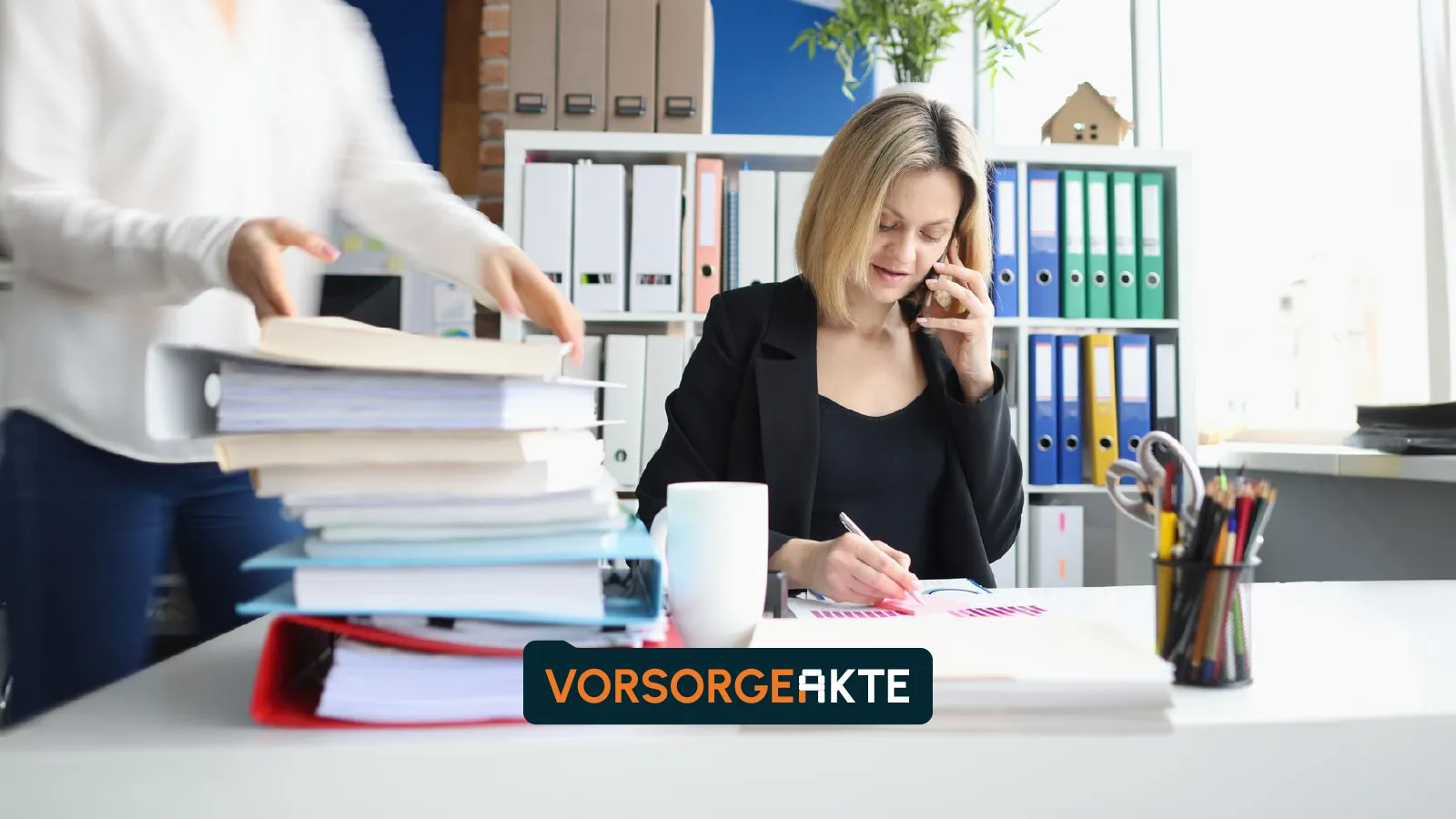 Another file? How the pension file puts files to rest
There are many things in life that make you think: „I definitely need more of that.“ Holidays, for example. Or coffee. Perhaps Wi-Fi on the train, too. And then there are things that instantly make you think the opposite. Right at the top of this list: files. And, as we all know, Germany has a special relationship with files. There are personnel files, tax files, medical records, building plans, The X-Files and probably, somewhere, a file about your files.
 Why every family needs an estate planning file
In everyday life, a lot of things just work. Bills get paid, insurance policies run in the background, and important documents are tucked away somewhere in folders, drawers or digital storage. You have a rough idea of where things are. And if not, you’ll find them one way or another. However, it is precisely this „one way or another“ that is the problem. Because as long as nothing goes wrong, it’s hard to notice just how unstructured much of our information actually is.






 German
  English