

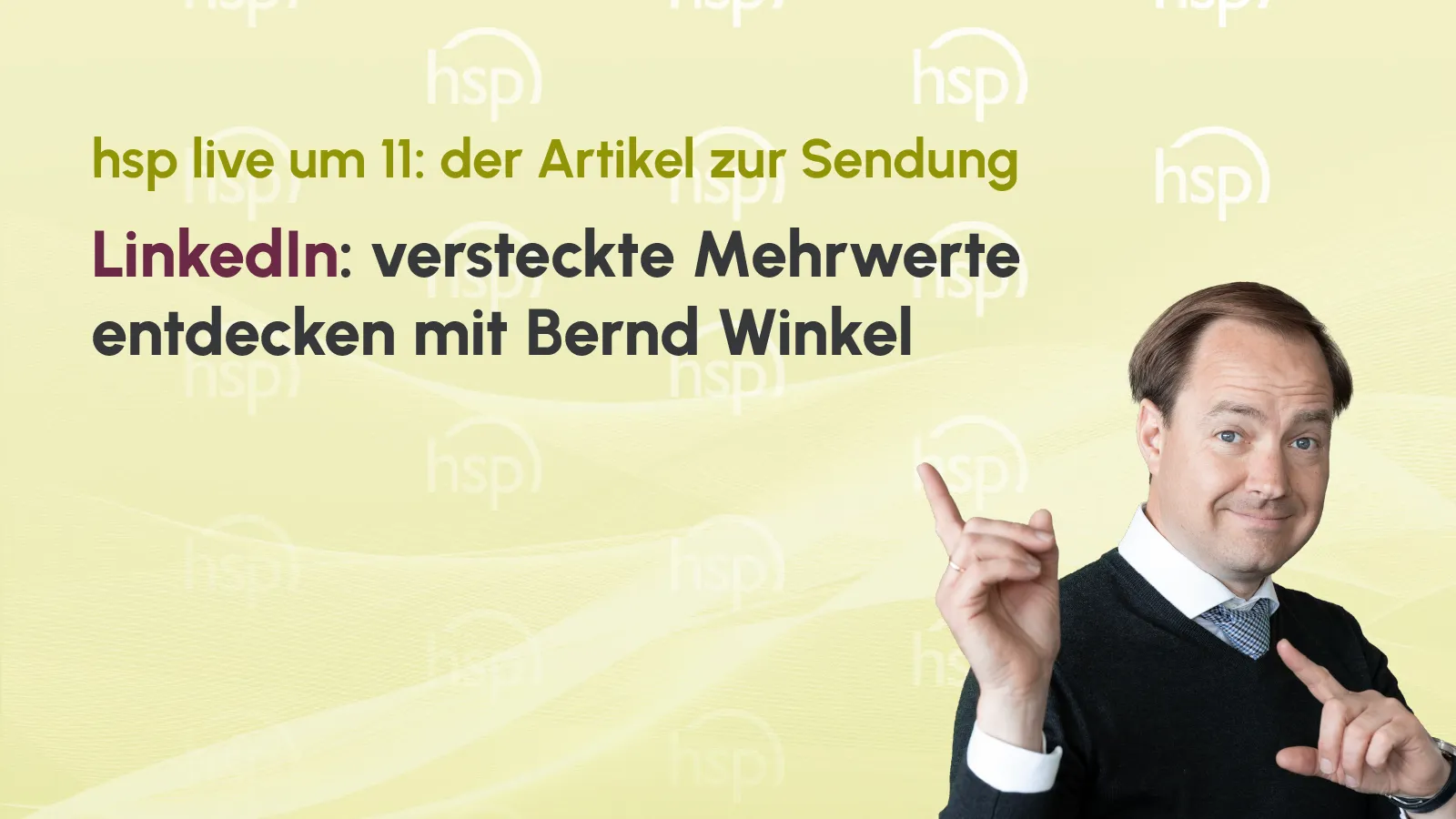
LinkedIn: Discover hidden added value with Bernd Winkel

During the live broadcast on 13 September 2023, hsp captain Paul Liese and LinkedIn expert Bernd Winkel discussed the latest developments on the business network.
Paul has realised that, over the past few months, he has been scaling back his activity on LinkedIn more and more. The reason: the platform is becoming too much like another Facebook. Nothing but profile photos in the timeline, nothing but casual, leisure-oriented posts. Paul no longer felt that his business content belonged there. Is LinkedIn increasingly becoming just another run-of-the-mill social network? Bernd sees the problem as being that people and companies can no longer organically expand their reach. Market saturation is leading to a sort of stagnation in user numbers and interactions. These days, it’s not just business professionals who are interested in the platform, but also school pupils, students and tradespeople. On the other hand, large user numbers also offer opportunities to reach a wide audience.
Paul asks whether the 90-9-1 rule still applies. It states that 90 per cent of users simply consume content. 9 per cent interact with content – that is, they like or comment on posts from time to time. Only 1 per cent of all users create and post their own content – or content they pass off as their own. Bernd points out that this shift in perspective can be fascinating. Instead of being part of the 99 per cent, individuals and businesses can decide at any time to join the 1 per cent. Whether the figures are scientifically accurate at the end of the day remains to be seen.
Reach isn’t everything on LinkedIn
So should everyone who is active on LinkedIn simply carry on doing their own thing? Paul, for example, asks whether the content of a profile affects the reach of organic posts. Bernd cannot confirm this definitively. However, as a professional, he recommends that you focus on communicating a single topic as much as possible, both in your profile and in your own posts. This topic should also be borne in mind when sharing and commenting on other people’s posts. In this way, you can position yourself as an expert in a particular field in the long term. Nowadays, people trust individuals far more than brands, especially when those individuals are well-known. A consistent presence on social media, combined with a specific focus on a particular topic, helps build the necessary recognition.
Reach isn’t everything. Content outside one’s area of expertise can generate enormous reach, but it doesn’t necessarily provide any added value for the person posting it. If Paul were to achieve reach with a video of a dog or a cat, this would have no impact on the success of the hsp brand or the Opti.Tax product. „What’s the point of going viral if you’re not consistent?“ says Bernd. It is far more important for Paul to be recognised and approached by people from his target audience at trade fairs.
Not everything works organically on LinkedIn
Bernd isn’t surprised that company pages don’t generate a great deal of reach. On LinkedIn, reach seems to be available only if you pay for it – at least when it comes to companies. Whilst this certainly keeps the cash flowing at LinkedIn, only time will tell whether the business model is sustainable in the long term. What’s more, people much prefer to follow other people rather than a brand or a company. That’s why the „Paul Liese“ account is far more important than the „hsp“ company page.
According to Paul, recruitment works exceptionally well on LinkedIn. With just a few clicks, interested parties can find out about people and companies. Regular posts about people, products and topics, as well as the company’s activities and commitments outside the office, provide a lively insight into a company. Making contact is, by its very nature, one of the simplest functions on LinkedIn. Paul also notes that it might be helpful if it weren’t just the management who were promoting their own company. Bernd can envisage, for example, an employee from the law firm acting as an ambassador. This person could use social media to present an authentic glimpse into the day-to-day life of a law firm. However, Bernd points out that it should be agreed in advance what tasks the person will take on, how to respond in a crisis situation, and what happens if the person leaves the company.
Final question: Does Bernd use AI-powered tools such as the ChatGPT chatbot? Bernd confirms that he does use them for brainstorming, to reach a conclusion more quickly. He is also keeping a close eye on AI-powered programmes in the video sector.





 German
  English