

Intelligent taxonomy software can do much more than just produce annual accounts and e-balance sheets
For many tax advisers and auditors, the term ‘taxonomy’ is primarily associated with e-balance sheets and annual accounts. This is because, when reporting to the tax authorities, there has been no way round the prescribed taxonomies since 2013 at the latest. Other areas of traditional financial reporting, such as the submission of disclosures or filings to the Federal Gazette, the Digital Financial Report (DiFin), or credit checks and ratings, are also increasingly being handled on the basis of taxonomies. What is less well known is that taxonomy solutions can also be used as extremely powerful tools for compliance tasks.
In particular, comprehensive taxonomy solutions such as hsp Opti.Tax offer a wide range of options and functions that enable not only financial reporting but also the documentation of compliance matters to be carried out securely, consistently, efficiently and conveniently.
Being organised is half the battle (when it comes to finances)
According to Wikipedia, a taxonomy is a standardised procedure or model used to classify data, information or objects according to specific criteria, that is, to organise them into categories or classes (also known as taxa). This standardised classification makes it easier to deal with individual cases and enables generalised statements to be made, right through to an explanation of interrelationships. It requires clarity regarding the differences between the categories and thus leads to a better understanding of the field of study. The hsp provides various taxonomies for different subject areas.
Advanced Financial Reporting
In the area of financial reporting, the taxonomies specified by the Federal Finance Administration are used. These comply with international standards and, in addition to mandatory reporting requirements, also facilitate open and efficient financial communication, for example with banks, investors or rating agencies. Alongside traditional methods such as annual accounts, e-balance sheets and publication in the Federal Gazette, the digital financial report is becoming increasingly important, particularly in communications with business partners and stakeholders.
Designing compliance documentation efficiently
Intelligently applied taxonomy solutions are also gaining ground in the field of compliance documentation. They are used, for example, to produce procedural documentation, a tax compliance management system, transfer pricing documentation, cash register documentation, a data protection report or a money laundering risk analysis.
For these tasks, hsp provides taxonomies developed in-house which, for example, also reflect sector-specific characteristics.
The taxonomies are divided into report sections (chapters or categories). Each report section contains a clear structure organised by folders and items and guides the user through the subject matter. The user decides whether or not to complete the listed items – depending on the circumstances and the situation within the company or client organisation (see screenshot below).
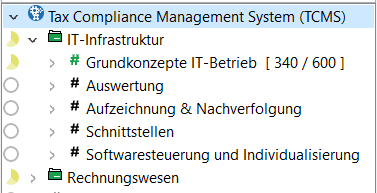
Every item in a taxonomy has clearly defined properties. These properties determine, for example, whether the item is relevant to a topic or not. In the „Process and Procedure Documentation“ project type, this relevance determines, for example, whether only those items that are relevant to the creation of procedure documentation are displayed.
Once a value has been recorded in a taxonomy item, it can be consistently carried over into correction and follow-up projects. This is because each taxonomy item contains a unique technical ID, which remains unchanged throughout the entire lifecycle of a taxonomy.
Data is retained during updates
Both new legal requirements and user requests may mean that taxonomies need to be adapted or expanded. For example, if a user has a Procedural documentation Once created, the user can transfer all data from the previous project into a new project when updating to a newer version. The user will have access to both the existing data and all new items provided with the new version of the taxonomy. The user can then decide for themselves whether and which of the new items they wish to use for their documentation tasks.
Another important feature of using a taxonomy is that only the items that are actually used appear in the report. If items in a taxonomy are not used, they remain hidden in the report. This means there are no references to sections that contain no data.
References within taxonomies save time and ensure consistency
Links between different items in a taxonomy allow the user to jump from one item to the next. This means that all information needs to be documented only once, as it is referenced repeatedly throughout the documentation. Data updates are also automatically applied to all references and links.
The example of the Tax Compliance Management Systems: This means that the process steps recorded in the procedural documentation can be linked directly to a control type and documented automatically. This ensures security, transparency and efficiency.
So it’s high time we made the most of all the benefits a taxonomy has to offer!












 German
  English