


Process management and process documentation: Why modern software must be capable of both
In this article, you will learn why modern software is essential for process management and process documentation, how the two terms differ, and what features a high-performance solution must offer today.
Using the Opti.Tax solution, we demonstrate how digital process documentation, automated BPMN modelling, artificial intelligence and integration with Microsoft 365 can be combined to create an effective process management system.
Whether you work in a tax consultancy, a medium-sized business or a large corporation – this article will help you find the right software to make your processes transparent, manageable and compliant with the law.

What is the difference between process management and process documentation?
Conclusion: Modern software for process management and process documentation must support both – the structured mapping of processes and their ongoing development in day-to-day operations.
What should a process management and process documentation software system be able to do?
Effective process management software should include the following core functions:
Opti.Tax: The process management software that brings processes to life
Opti.Tax is a smart solution that digitises process documentation whilst enabling targeted process management – all integrated into the working environment in which people operate on a daily basis.
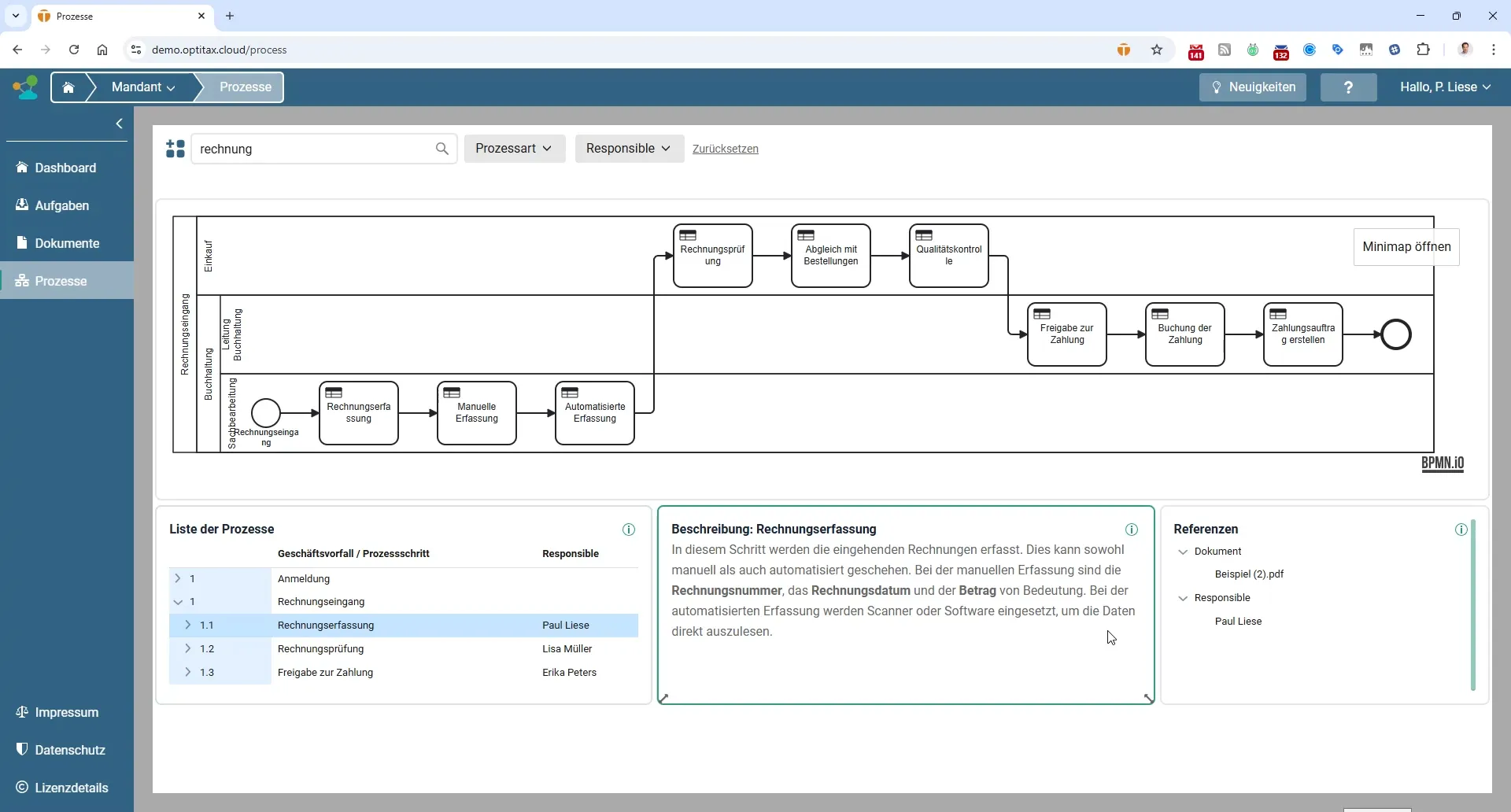
Automatic BPMN modelling and AI support
A key feature: Opti.Tax automatically generates BPMN diagrams based on the textual process description. This not only makes visualisation easier, but also makes complex processes easier to understand.
In addition, an integrated artificial intelligence system supports users by providing suggestions for typical workflows, role assignments, checkpoints and standard wording – ideal for business users with no prior knowledge of process modelling.
Seamless integration with Microsoft 365
Thanks to its deep integration with Microsoft 365, Opti.Tax becomes an integral part of day-to-day operations:
- Microsoft Teams: Processes are directly integrated into channels, and changes can be discussed and agreed upon.
- Microsoft Outlook: Tasks and deadlines appear in the calendar and as reminders.
- Microsoft To Do: Process steps can be tracked as personal tasks.
Another highlight: as soon as a process step is changed, everyone affected is automatically notified by email or via Teams. This ensures that no one is left in the dark, changes are implemented immediately, and everyone involved is always working with the latest procedures.
Compliance, oversight and transparency
Opti.Tax enables you to create GoBD-compliant procedural documentation, including evidence for GDPR and ICS. Version control, approval mechanisms and task tracking make the software a reliable foundation for audits and internal reviews.
Why process documentation alone is no longer sufficient
Many companies document their processes in Word, Excel or Visio. Such documentation quickly becomes out of date, is not put into practice and leads to uncertainty in day-to-day operations.
Only with integrated software for process management and process documentation, such as Opti.Tax, do processes become visible, manageable and implementable. It combines structure with practical application, and documentation with action.






 German
  English