


Transfer pricing documentation: what you need to know
What are transfer prices? Can you give an example?
Transfer prices are the internal prices at which companies settle internal transactions between group companies, such as the sale of goods or services between subsidiaries.
How are transfer prices determined?
Transfer prices are generally determined on the basis of comparable market prices or other recognised methods, such as cost-plus or a profit margin.
What does „transfer pricing documentation“ mean?
Transfer pricing documentation is a compilation of information and records that a company prepares to document and justify its transfer prices. This is intended to ensure compliance with transfer pricing regulations and to provide transparency to the tax authorities.
We have been developing compliance and reporting solutions for professionals for decades.
The software uses the BZSt taxonomy, so you won’t miss a thing.
We keep the software up to date with free updates.
Good to know
What is transfer pricing documentation?
Transfer pricing documentation, also known as „Transfer Pricing Documentation“, is an important part of tax compliance for companies with international business dealings. It serves to demonstrate that the prices charged for transactions between associated companies are arm’s length.
Transfer prices are the prices at which transactions between associated companies (e.g. subsidiaries) are carried out. They must be appropriate, i.e. realistic and justifiable. This is intended to ensure that profits are distributed fairly amongst the associated companies. Otherwise, companies could avoid paying tax by artificially shifting profits.
Transfer pricing documentation must contain certain information
Transfer pricing documentation contains detailed information on the business relationships between the associated enterprises, the nature of the transactions carried out, and the appropriate transfer prices. It should also set out the method used to determine the arm’s-length transfer prices, as well as the supporting documentation used to substantiate that method.
There are various methods for determining appropriate transfer prices, including the comparable uncontrolled price method, the profit margin method and the transaction method. The choice of method depends on the nature of the transactions and the availability of comparable data.
Companies operating internationally are required to document their transfer pricing
It is important to note that transfer pricing documentation is not prepared solely for tax purposes. It also serves as evidence for the tax authorities that arm’s-length prices have been used. Companies must therefore ensure that their transfer pricing documentation is accurate and complete in order to avoid potential tax risks.
In some countries, there are legal requirements regarding the preparation and retention of transfer pricing documentation. Companies must comply with these requirements. It is therefore important to find out separately about the applicable legal requirements in the countries in which the company operates.
Who is required to prepare transfer pricing documentation?
Transfer pricing documentation must be prepared and retained by companies that carry out cross-border transactions with associated enterprises. Associated enterprises are enterprises that are economically dependent on one another, such as subsidiaries, sister companies or enterprises controlled by the same owner.
As a general rule, companies registered under the German Commercial Code (HGB) or the Publicity Act (PublG) are required to prepare and retain transfer pricing documentation. These companies are generally of a certain size and have complex business structures.
There are other cases in which transfer pricing documentation is required
Sometimes, even smaller companies or partnerships are required to prepare transfer pricing documentation when they carry out transactions with associated companies. You should also bear in mind that, in some cases, transfer pricing documentation is required for certain actions to be legally valid, for example when incorporating a limited liability company (GmbH) or when making changes to the commercial register.
Unrivalled in terms of convenience and security
Opti.Tax: the software tool for transfer pricing
The Opti.Tax Transfer Pricing Documentation software solution was developed in collaboration with the transfer pricing team at the Düsseldorf-based law firm ADKL, led by Lisa Hägele and Tobias Polka.
The result of this collaboration: a uniquely user-friendly, well-designed software tool for documenting transfer pricing.
Opti.Tax software platform
One platform, lots of possibilities, no media breaks
The „Transfer Pricing Documentation“ module is part of the Opti.Tax platform. The term ‘module’ means that it is a software tool. It can be purchased and used on its own, but can also be combined with other modules. The term ‘software platform’ means that all modules share a common base.
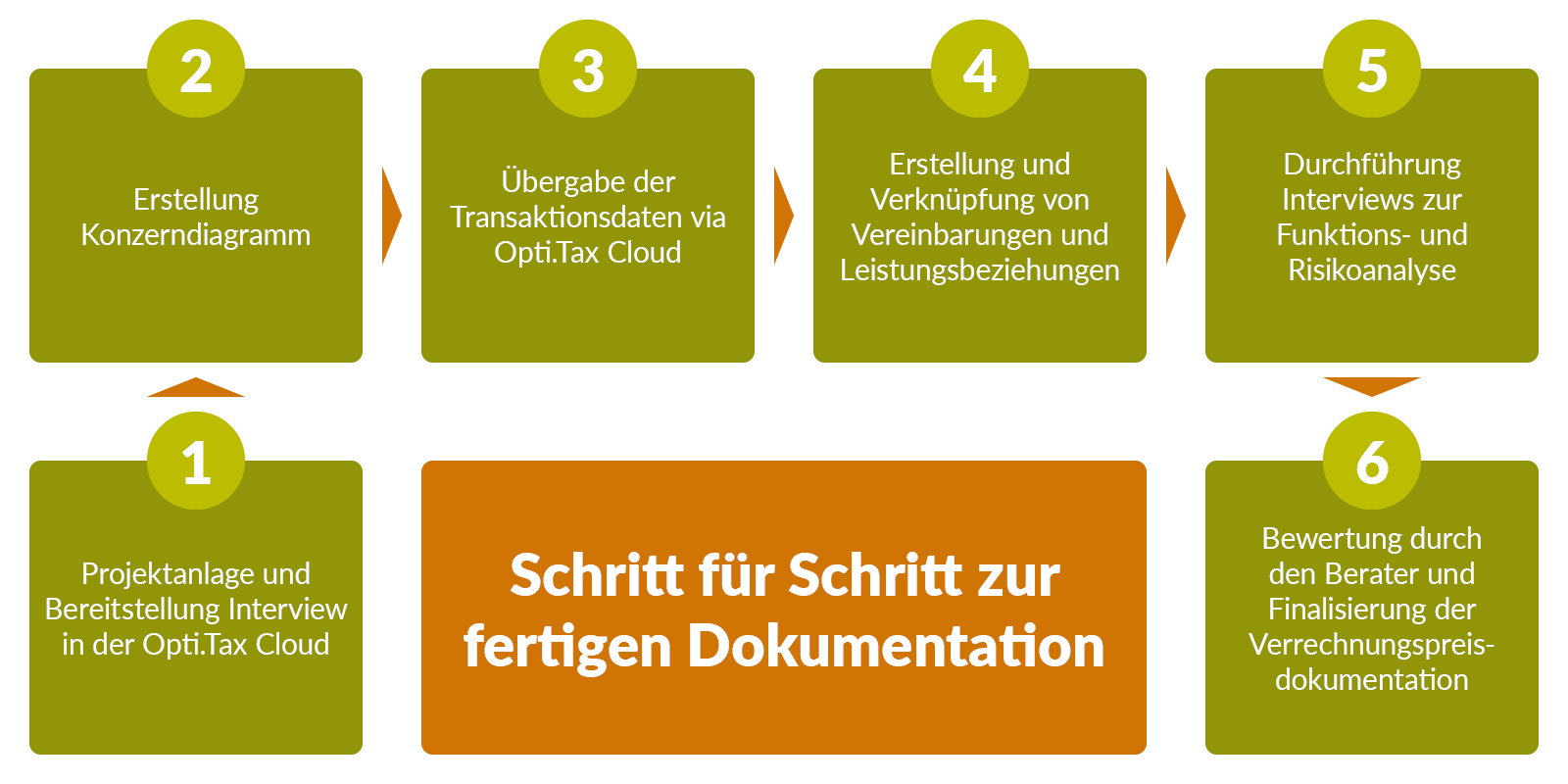
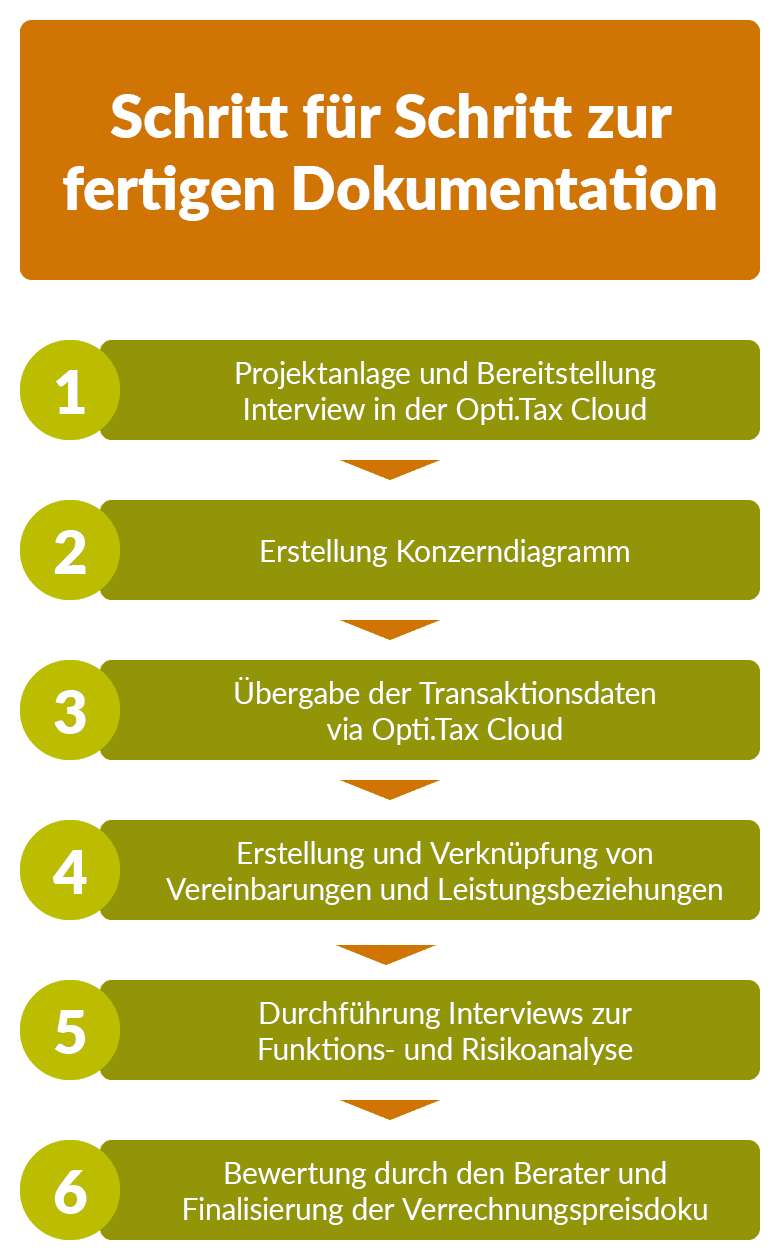
The „Procedural Documentation“ module in Opti.Tax guides you step by step and in a structured manner through the process of producing complete, comprehensive documentation. At each step, documentation of service relationships and agreements is automatically generated in the background. Validation rules ensure that the software alerts you to any missing items. These can be completed by you or assigned to third parties, such as the client.
By dragging and dropping Create service relationships
Task for the client in the Opti.Tax Client create
The client replies in the Opti.Tax Cloud seamless
Translation without a break in the media stream – DeepL integrated
What the authorities expect
How to get off to a good start
How we develop software
FAQ – Frequently Asked Questions
Frequently Asked Questions (FAQs) on transfer pricing
Your message to us
How can we help you?

About hsp – Software innovation made in Germany
Since 1991, hsp Handels-Software-Partner GmbH has been developing professional software solutions for tax consultancy and audit firms, as well as for businesses.
Our taxonomy software Opti.Tax has established itself amongst discerning professionals in the DACH region as the reliable, high-performance and long-term solution for electronic invoicing. The digital tools for legally required, GoBD-compliant documentation are particularly popular.
Practical relevance, up-to-date content and genuine service
Our software modules are developed in close collaboration with experienced partner firms such as Energiesozietät GmbH for internal control systems (IKS), ADKL Abels Decker Kuhfuß & Partner mbB for transfer pricing, and Schröder & Partner for the digital pension file. In this way, we ensure that the features in Opti.Tax are tailored to the real-world challenges of day-to-day professional practice.
Regular updates ensure that changes to legislation and new requirements are incorporated into the software in a timely manner. In addition, we support you with a comprehensive range of service and support offerings, e-learning courses, access to the hsp Community, our weekly live broadcast „hsp live at 11“ and much more.






 German
  English