What is procedural documentation?

Procedural documentation in accordance with GoBD describes all the processes within a company or organisation that are used to record and retain business transactions relevant for tax purposes.

Who is required to draw up procedural documentation?

Every business and every freelancer is required to draw up procedural documentation. This documentation must be updated regularly.

Why create procedural documentation?

Procedural documentation is mandatory. If you are unable to provide complete and accurate procedural documentation during a tax audit, you face severe penalties. However, this documentation also offers many benefits, such as serving as a basis for process optimisation or digitalisation consultancy.

About the author

Paul Liese
Paul Liese
hsp Software

Paul Liese is the managing director of hsp Handels-Software-Partner GmbH in Hamburg. For many years, he has been involved in the Software and IT specialist with the topics relating to electronic invoicing. These include, in particular, procedural documentation, Tax CMS, transfer pricing and the internal control system. Together with his team, Paul Liese is working on the Elimination of all media breaks in accounting.

Step by step towards living documentation

Creating process documentation: everything you need to know

Process documentation in accordance with GoBD sets out all the processes of a company or a self-employed person. It records not only the process chains and workflows, but also the relevant positions and individuals responsible.

But what are the benefits for companies of drawing up procedural documentation? Who can help if a company wants to have procedural documentation drawn up? We have compiled the key information for anyone wishing to draw up procedural documentation.

Also for tax advisers

Do you work in tax consultancy? If so, you really ought to make procedural documentation a priority on your agenda. Firstly, many companies turn to their tax practice when it comes to documentation. Secondly, you can use procedural documentation as a basis for offering further services, such as process or digitalisation consultancy. And thirdly, you too are obliged to draw up procedural documentation for yourself or your firm.

Creating procedural documentation – what are the benefits for me?

Companies and freelancers are constantly being told that they should draw up procedural documentation. But what added value does documentation offer?

Benefits of process documentation:

  • The management team gets to know their own company properly – specifically, its actual current state
  • Process documentation forms the basis for process optimisation and digitalisation
  • Security during a tax audit

Decision-makers within companies believe they have a sufficient understanding of their own internal processes. However, tax accountancy firms repeatedly find that management is usually only familiar with the theoretical procedures – if at all. In day-to-day practice, completely different process chains have often become established. There may be various reasons for this.

If, for example, there is a shortage of staff or a lack of clearly defined responsibilities, many teams begin to work with what is available and improvise. Elsewhere, a new manager may bring processes learnt externally into the organisation and introduce their own procedures. The larger the organisation, the more frequently structures develop a life of their own. With process documentation, these are regularly identified, analysed and monitored.

What should be included in procedural documentation?

The process documentation is intended to record the current status of all processes within the organisation.

  • Staff duties and responsibilities, and arrangements for cover
  • Software and technology used
  • all of the company’s business processes

By maintaining procedural documentation, the company can ensure that a consistent standard of quality is upheld across all business processes. It also ensures that its own processes comply with the requirements of the accounting department and the tax authorities. Furthermore, the information contained in procedural documentation can shorten the induction period for new staff. It also enables training and development needs to be identified more quickly.

Ensure compatibility with the tax authorities

Important: Procedural documentation should not be available solely in paper form or as a Word file. Instead, you should use software that utilises the taxonomy-based XBRL format to create the documentation. This ensures that the tax authorities can access your documentation easily and without any disruption to the data format during a digital tax audit.

How do I draw up procedural documentation?

In order to draw up procedural documentation, the persons responsible for documentation must carefully record all processes within the company. Each process is described in detail. The sequence of steps is also documented, so that every action taken by the company can be traced.

The document should be reviewed regularly and updated where necessary. Out-of-date procedural documentation is not only useless, but is also unsuitable for tax audits. The company should regularly review the accuracy and relevance of its documentation – usually on an annual basis.

Creating procedural documentation within a company

Very few company managers are exactly jumping for joy when it comes to process documentation. Yet the benefits and added value far outweigh the effort involved. For most SMEs, process documentation can be drawn up in just a few hours. The annual updates take hardly any time at all. In return, the company gains a solid foundation for process optimisation, digitalisation projects and other future initiatives.

If you wish to draw up procedural documentation for your business, specialised documentation software will help you achieve your goal quickly. The cost of such software is more than offset by the time saved and the frustration avoided. The software should support the XBRL format and feature an interview mode, such as Opti.Tax from hsp. During the interview, you’ll be asked a series of questions. Based on your answers, the software automatically generates the procedural documentation – it couldn’t be simpler.

Video on creating procedural documentation using Opti.Tax
For privacy reasons YouTube needs your permission to be loaded. For more details, please see our Datenschutz.

Have procedural documentation drawn up

Many companies and self-employed professionals wish to outsource the task of compiling procedural documentation. Companies without their own tax department or specialist knowledge of documentation, in particular, have their procedural documentation drawn up externally.

The most common options:
Option 1
Hire a tax adviser or an auditor

Many law firms and tax consultancy firms offer the preparation of procedural documentation as a service.

  • Benefits for tax advisers: Viele Daten, die zur Erstellung einer Verfahrensdokumentation benötigt werden, sind bereits vorhanden. Außerdem können Steuerkanzleien mithilfe einer Verfahrensdokumentation den Mandanten besser betreuen und beraten.

Option 2
Online-Plattform nutzen

Zahlreiche Dienstleister bieten Onlinedienste an, wo Sie über einen Webservice eine Verfahrensdokumentation erstellen lassen können.

  • Vorteil bei einer Online-Plattform: Die Registrierung bzw. Beauftragung ist schnell, da alles online und sofort erledigt werden kann.

  • Nachteile bei einer Online-Plattform: Der fehlende persönliche Kontakt mindert die Beratungsleistung. Da die Anbieter Sie nicht kennen, können diese auch nicht auf spezifische Besonderheiten und Details eingehen, die einer Steuerberatung sofort aufgefallen wären. Zudem haben Sie nicht sofort eine persönliche Kontaktperson zur Hand, wenn beispielsweise bei einer Betriebsprüfung Fragen oder Beanstandungen auftauchen.
Verfahrensdokumentation für andere erstellen

Viele Selbständige und Unternehmen wenden sich mit dem Thema Verfahrensdokumentation an ihre Steuer- oder Wirtschaftsprüfungskanzlei. Für Steuerberater:innen und Wirtschaftsprüfer:innen bedeutet das:

  • Mit der notwendigen Kompetenz sind zusätzliche Einnahmen möglich
  • Die Dokumentation kann als Basis für weitere Geschäftsfelder genutzt werden
  • Die Software zur Erstellung der Verfahrensdokumentation sollte für die medienbruchfreie Zusammenarbeit mit Mandanten geeignet sein, etwa durch einen integrierten Clouddienst

Sollten Sie in der Steuerberatung oder Wirtschaftsprüfung tätig sein, erstellen Sie Ihre erste Dokumentation für sich selbst bzw. für Ihre Kanzlei. Damit sammeln Sie erste Praxiserfahrungen, identifizieren ggfs. Optimierungspotenziale in Ihrem Hause und erfüllen Ihre Pflicht gegenüber den Finanzbehörden.

Entscheidungshilfe: Soll ich meine Verfahrensdokumentation selbst erstellen – oder erstellen lassen?

Sie sollten Ihre Verfahrensdokumentation selbst erstellen und aktuell halten, wenn Sie:

  • überschaubare Prozesse haben, etwa als Freiberuflerin oder Kleinunternehmer
  • eine Fachperson oder Fachabteilung im Unternehmen haben, die eine Verfahrensdokumentation erstellen kann

  • eine Fachperson aus den Bereichen Steuerberatung oder Wirtschaftsprüfung sind, die die Verfahrensdokumentation auch als Dienstleistung anbieten möchte

Sie sollten Ihre Have procedural documentation drawn up, wenn Sie:

  • komplexe Prozesse und/oder viele Verantwortlichkeiten haben
  • sich keine Gedanken um das Thema Verfahrensdokumentation machen möchten

  • erinnert werden möchten, wenn die Dokumentation aktualisiert werden muss
  • sichergehen möchten, dass Sie bei einer Betriebsprüfung unterstützend begleitet werden
  • im Zuge der Dokumentation beraten werden möchten
  • für die verlässliche Bewertung der eigenen Prozesse einen externen Blick wünschen
  • von der Dokumentation als Basis für weitere Beratungsleistungen profitieren möchten, etwa Prozessoptimierung und Digitalisierung

Jetzt kostenlos beraten lassen

Die Software für Verfahrensdokumentation: Opti.Tax für Steuerkanzleien und Unternehmen

Tausende Steuerkanzleien, Wirtschaftsprüfer:innen und Unternehmen erledigen das Thema Verfahrensdokumentation mit einer Software-Innovation made in Germany: Opti.Tax. Mit der intelligenten Taxonomie-Software und dem herausragenden hsp-Service können Sie ganz bequem alle Doku-Aufgaben abhaken:

  • Prozesse dokumentieren
  • Schwächen identifizieren
  • digitale Chancen entdecken

Zuverlässig, intuitiv zu bedienen, GoBD-konform: Nutzen Sie mit Opti.Tax das richtige Werkzeug, um unkompliziert eine echte Mehrwertdokumentation zu erstellen.

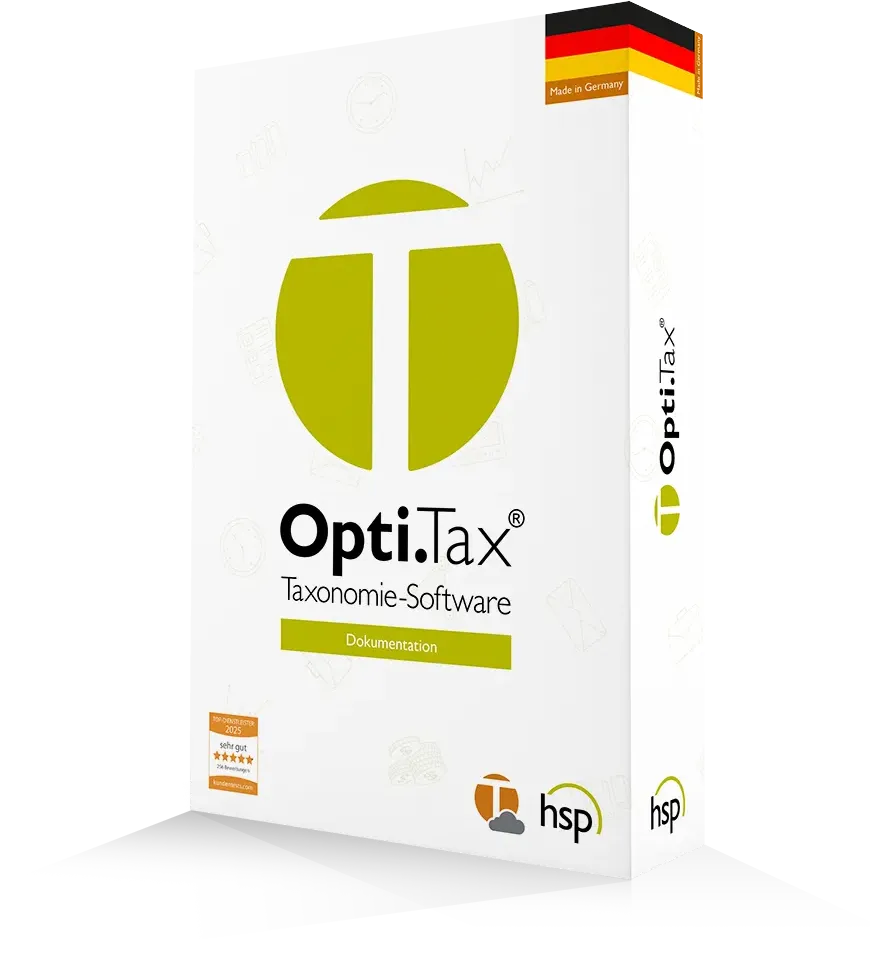
Packshot of the Opti.Tax software documentation

Can't find a suitable date, or is the calendar not working?

Eine Softwarelösung, die Maßstäbe setzt

Ihre Vorteile mit Opti.Tax für Ihre Verfahrensdokumentation

Clear and well-organised

Erstellen Sie ganz einfach eine übersichtlich gegliederte Verfahrensdokumentation, die vollständig und schlüssig ist – sowohl als Textdokument als auch grafisch dargestellt.

Einfach

Nutzen Sie beim Erstellen der Dokumentation den Interview-Modus. Durch die Beantwortung von Fragen entsteht automatisch die Verfahrensdokumentation.

Schnell

Für Unternehmen etlicher Branchen stehen Ihnen bei Opti.Tax Muster-Dokumentationen zur Verfügung. Einfach laden, anpassen und wertvolle Zeit sparen.

Sicher

Erstellen Sie eine Dokumentation, auf die sachverständige Dritte problemlos zugreifen können. Nutzen Sie dabei eine Software, die Ihre sensiblen Daten sicher verarbeitet.

BAFA-Fördergeld direkt in Opti.Tax beantragen

Das Bundesamt für Wirtschaft und Ausfuhrkontrolle (BAFA) fördert Beratungsleistungen, die von Unternehmen in Anspruch genommen werden. Wenn Sie in der Steuerberatung tätig sind, können Sie Ihren Mandanten etwa zur Digitalisierung beraten – und gleichzeitig für Ihren Mandanten Fördergelder für diese Leistung beantragen.

Mit dem Modul Beratungsförderung in Opti.Tax erledigen Sie das alles direkt aus der Software heraus:

  1. Akkreditierung beim BAFA beantragen: Alle Unterlagen stellen Sie bequem in Opti.Tax zusammen.
  2. Create a consultancy report: You advise your client and use Opti.Tax to draw up a well-structured advisory report.
  3. Applying for BAFA funding: You can submit your grant application easily and conveniently using the software.
Amount of the BAFA consultancy grant

Location of the advisory permanent establishment

Flow rate

Maximum grant

  • New Federal States (excluding the State of Berlin and the Leipzig region)
  • Lüneburg region
  • Trier region

80 %

2800 €

  • Old federal states (excluding the Lüneburg region and the Trier region)
  • State of Berlin
  • Leipzig region

50 %

1750 €

Eligible consultancy costs:

Consultancy costs that are not eligible for funding:

  • Consultancy firm’s fee
  • any travel expenses incurred by the consultancy firm
  • Value Added Tax
  • Certification costs

Source: Federal Office for Economic Affairs and Export Control (BAFA), Information Sheet on Grants, Payments and Proof of Payment dated 1 January 2023. No guarantee can be given as to the accuracy or currency of the information provided.

Special offer: guided BAFA accreditation included!

Are you up to your ears in work and haven’t yet been accredited by the BAFA? No problem: when you order Opti.Tax, you’ll receive a step-by-step guide to BAFA accreditation free of charge!

  • personal digital tutorial
  • Step by step towards accreditation
  • Eligibility criteria for funding

Creating process documentation with clients

Many companies combine the tax expertise of their tax consultancy with the business-strategic aspect of procedural documentation. In this context, it is particularly important that the software solution used is a digital collaboration between the law firm and the client enables. Opti.Tax not only enables this, but also takes seamless communication between tax firms and businesses to a whole new level.

The Opti.Tax software solution offers a wide range of features for the joint creation and maintenance of procedural documentation. These include interfaces with taskplace.de and steuerbuero.online, seamless data requests and retrieval via the Opti.Tax Cloud, and more.

Developed for you in Hamburg

Why so many professionals put their trust in hsp

Julian Rodewald is our support team leader

Excellent support

A software solution is only as good as the support that comes with it, particularly when it comes to specialist software. That is why we offer you:

  • Comprehensive onboarding with a personal appointment for you or your staff
  • Personal assistance from our support team led by Julian Rodewald
  • A comprehensive help centre with countless technical questions and answers about the software

ADKL: Tax advisers Lisa Hägele and Tobias Polka use the Opti.Tax software

Unrivalled practical relevance

Only experts know what professionals like you really need. That is why we work with leading law firms:

  • Experts in the field support our software development
  • Strong partners: ADKL, Energiesozietät, Schröder & Partner, Clostermann & Jasper, and others.

  • New features are regularly implemented in response to customer requests

Two software developers from hsp at their workstations

Made in Germany

Our development, testing and support teams are based in Hamburg. Our servers are located in Munich. There are good reasons for this:

  • All data is processed in accordance with strict EU legislation and the GDPR

  • You need to be able to rely on software and support – and that’s only possible locally
  • We need to be just as familiar with German laws and regulations as you are

More on the subject of process documentation

About hsp – Software innovation made in Germany

We eliminate media breaks for you

Since 1991, hsp Handels-Software-Partner GmbH has been developing professional software solutions for tax consultancy and audit firms, as well as for businesses.

Our taxonomy software Opti.Tax has established itself amongst discerning professionals in the DACH region as the reliable, high-performance and long-term solution for electronic invoicing. The digital tools for legally required, GoBD-compliant documentation are particularly popular.

Practical relevance, up-to-date content and genuine service

Our software modules are developed in close collaboration with experienced partner firms such as Energiesozietät GmbH for internal control systems (IKS), ADKL Abels Decker Kuhfuß & Partner mbB for transfer pricing, and Schröder & Partner for the digital pension file. In this way, we ensure that the features in Opti.Tax are tailored to the real-world challenges of day-to-day professional practice.

Regular updates ensure that changes to legislation and new requirements are incorporated into the software in a timely manner. In addition, we support you with a comprehensive range of service and support offerings, e-learning courses, access to the hsp Community, our weekly live broadcast „hsp live at 11“ and much more.

hsp logo in white