

What is procedural documentation?
Procedural documentation in accordance with GoBD describes all the processes within a company or organisation that are used to record and retain business transactions relevant for tax purposes.
Who is required to draw up procedural documentation?
Every business and every freelancer is required to draw up procedural documentation. This documentation must be updated regularly.
Why create procedural documentation?
Procedural documentation is mandatory. If you are unable to provide complete and accurate procedural documentation during a tax audit, you face severe penalties. However, this documentation also offers many benefits, such as serving as a basis for process optimisation or digitalisation consultancy.

Creating procedural documentation – what are the benefits for me?
Companies and freelancers are constantly being told that they should draw up procedural documentation. But what added value does documentation offer?
Benefits of process documentation:
Decision-makers within companies believe they have a sufficient understanding of their own internal processes. However, tax accountancy firms repeatedly find that management is usually only familiar with the theoretical procedures – if at all. In day-to-day practice, completely different process chains have often become established. There may be various reasons for this.
If, for example, there is a shortage of staff or a lack of clearly defined responsibilities, many teams begin to work with what is available and improvise. Elsewhere, a new manager may bring processes learnt externally into the organisation and introduce their own procedures. The larger the organisation, the more frequently structures develop a life of their own. With process documentation, these are regularly identified, analysed and monitored.
How do I draw up procedural documentation?
In order to draw up procedural documentation, the persons responsible for documentation must carefully record all processes within the company. Each process is described in detail. The sequence of steps is also documented, so that every action taken by the company can be traced.
The document should be reviewed regularly and updated where necessary. Out-of-date procedural documentation is not only useless, but is also unsuitable for tax audits. The company should regularly review the accuracy and relevance of its documentation – usually on an annual basis.
Creating procedural documentation within a company
Very few company managers are exactly jumping for joy when it comes to process documentation. Yet the benefits and added value far outweigh the effort involved. For most SMEs, process documentation can be drawn up in just a few hours. The annual updates take hardly any time at all. In return, the company gains a solid foundation for process optimisation, digitalisation projects and other future initiatives.
If you wish to draw up procedural documentation for your business, specialised documentation software will help you achieve your goal quickly. The cost of such software is more than offset by the time saved and the frustration avoided. The software should support the XBRL format and feature an interview mode, such as Opti.Tax from hsp. During the interview, you’ll be asked a series of questions. Based on your answers, the software automatically generates the procedural documentation – it couldn’t be simpler.
Have procedural documentation drawn up
Many companies and self-employed professionals wish to outsource the task of compiling procedural documentation. Companies without their own tax department or specialist knowledge of documentation, in particular, have their procedural documentation drawn up externally.
Many self-employed people and businesses turn to their tax or accountancy firm for advice on procedural documentation. For tax advisers and auditors, this means:
If you work in tax consultancy or auditing, you should draw up your first set of documentation for yourself or for your firm. This will enable you to gain initial practical experience, identify any areas for improvement within your firm, and fulfil your obligations to the tax authorities.
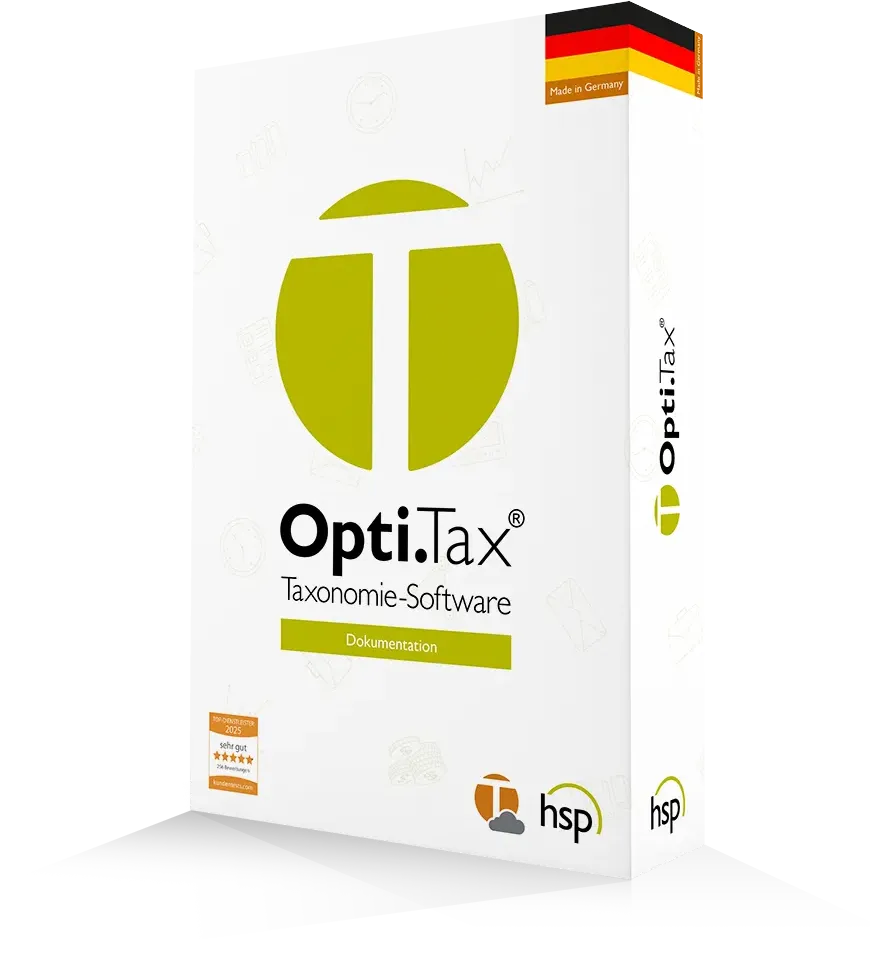
A software solution that sets new standards
The benefits of using Opti.Tax for your procedural documentation
The Federal Office for Economic Affairs and Export Control (BAFA) provides funding for consultancy services used by businesses. If you work in tax consultancy, you can, for example, advise your clients on digitalisation – and at the same time apply for funding on their behalf for this service.
With the ‘Consultancy Support’ module in Opti.Tax, you can do all this directly within the software:
- Applying for accreditation with the BAFA: You can easily compile all your documents in Opti.Tax.
- Create a consultancy report: You advise your client and use Opti.Tax to draw up a well-structured advisory report.
- Applying for BAFA funding: You can submit your grant application easily and conveniently using the software.
Eligible consultancy costs:
Consultancy costs that are not eligible for funding:
- Consultancy firm’s fee
- any travel expenses incurred by the consultancy firm
- Value Added Tax
- Certification costs
Source: Federal Office for Economic Affairs and Export Control (BAFA), Information Sheet on Grants, Payments and Proof of Payment dated 1 January 2023. No guarantee can be given as to the accuracy or currency of the information provided.
Are you up to your ears in work and haven’t yet been accredited by the BAFA? No problem: when you order Opti.Tax, you’ll receive a step-by-step guide to BAFA accreditation free of charge!
- personal digital tutorial
- Step by step towards accreditation
- Eligibility criteria for funding
Developed for you in Hamburg
Why so many professionals put their trust in hsp











 German
  English