


You can find news from December 2020 onwards here:
End of BAFA coronavirus support: answers and alternatives
As recent press reports have already suggested, it is now official: the Federal Office for Economic Affairs and Export Control (BAFA) has suspended the funding scheme for businesses affected by the coronavirus for the time being. What does this mean for consultants and clients? How can consultants find out which applications are still eligible for funding? Here you’ll find answers to the most important questions regarding the suspension of the BAFA consultancy funding scheme during the coronavirus crisis. You’ll also learn about the alternatives available.
A crisis the likes of which the modern world has never before experienced calls for swift action. The BAFA, too, set up an aid programme in record time, designed to provide straightforward and effective support. For this reason, consultancy services for businesses affected by the coronavirus were to be subsidised at a rate of €4,000 per consultation, with 100 per cent funding.

Unexpected surge in demand for BAFA coronavirus support
However, this led to a flood of applications for accreditation and funding. The BAFA soon found itself forced to put the programme on hold for the time being. On its official website, the BAFA states:
Due to high demand, the funds earmarked for this specific funding module have already been exhausted, and no additional funds can be made available. Funding from the special COVID-19 module has therefore been discontinued ahead of schedule. Consequently, for the time being, only those applications that have already been provisionally approved can be finalised and the funding paid out to the consultant.
Below, we would like to address the most common and pressing questions. We also set out alternative ways in which advisers and clients can deal with the changed situation.
Questions and answers about BAFA funding
We recommend that you bookmark this blog post in your browser and check back regularly. That way, you’ll stay up to date should any important details change or further questions and answers be added later on.
Many law firms have initiated the BAFA accreditation process using Opti.Tax. Now that these coronavirus-related funding programmes have been suspended, what will happen to applications for BAFA accreditation?
The accreditation process has not been halted. The consultant is being accredited. It is simply taking longer than it did two or three months ago, before the coronavirus funding triggered this huge rush. But the accreditation process itself has not been halted. This means that the application is being processed, and you will still have access to the BAFA consultancy grant once accreditation is complete.
I don’t need to be on the list to be able to submit grant applications on behalf of my client, do I?
That is correct. The guidelines stipulate that it is not necessary to be on the list in order to submit applications. Later, when the funding application is being processed, the BAFA must check whether authorisation has been granted. Whilst prior authorisation is advisable, time constraints may mean that applications can be submitted on behalf of the client even without authorisation.
Can law firms or consultants whose clients have already been given a letter of intent still go ahead with their project or provide their consultancy services?
Yes. If a commitment has already been made, the funding should also be paid out. Whilst there is no guarantee, there is also no valid reason why this should be otherwise. After all, a commitment means that the funds have been set aside in the budget.
What is the best course of action for law firms that have not yet received a letter of intent from the BAFA?
It is highly likely that you will receive a rejection. In this case, it is advisable to switch to the other module, provided the circumstances are right – namely, focusing on companies in difficulty or established businesses. Be proactive and do not wait for the rejection.
As a consultant, I worked hard to convince my client to take part in the coronavirus advisory programme. How do I break the news to him that the programme has been suspended?
It’s not your fault, it’s not ours – it’s down to circumstances beyond our control. So why not offer your clients the solution straight away: to adapt your advice to the new situation? To this end, we sent out a sample letter via our newsletter two days after the BAFA’s announcement. At the very bottom of this page, you can subscribe to the hsp newsletter, which regularly features the latest information and useful documents.
What alternative funding schemes does the BAFA offer?
In principle, the BAFA’s standard funding schemes continue to run: for start-ups, for established businesses and for businesses in difficulty. Start-ups are no more than two years old; established businesses are older. Companies in difficulty can be either start-ups or established companies and are defined by specific criteria; for example, 50 % of the share capital must have been used up.
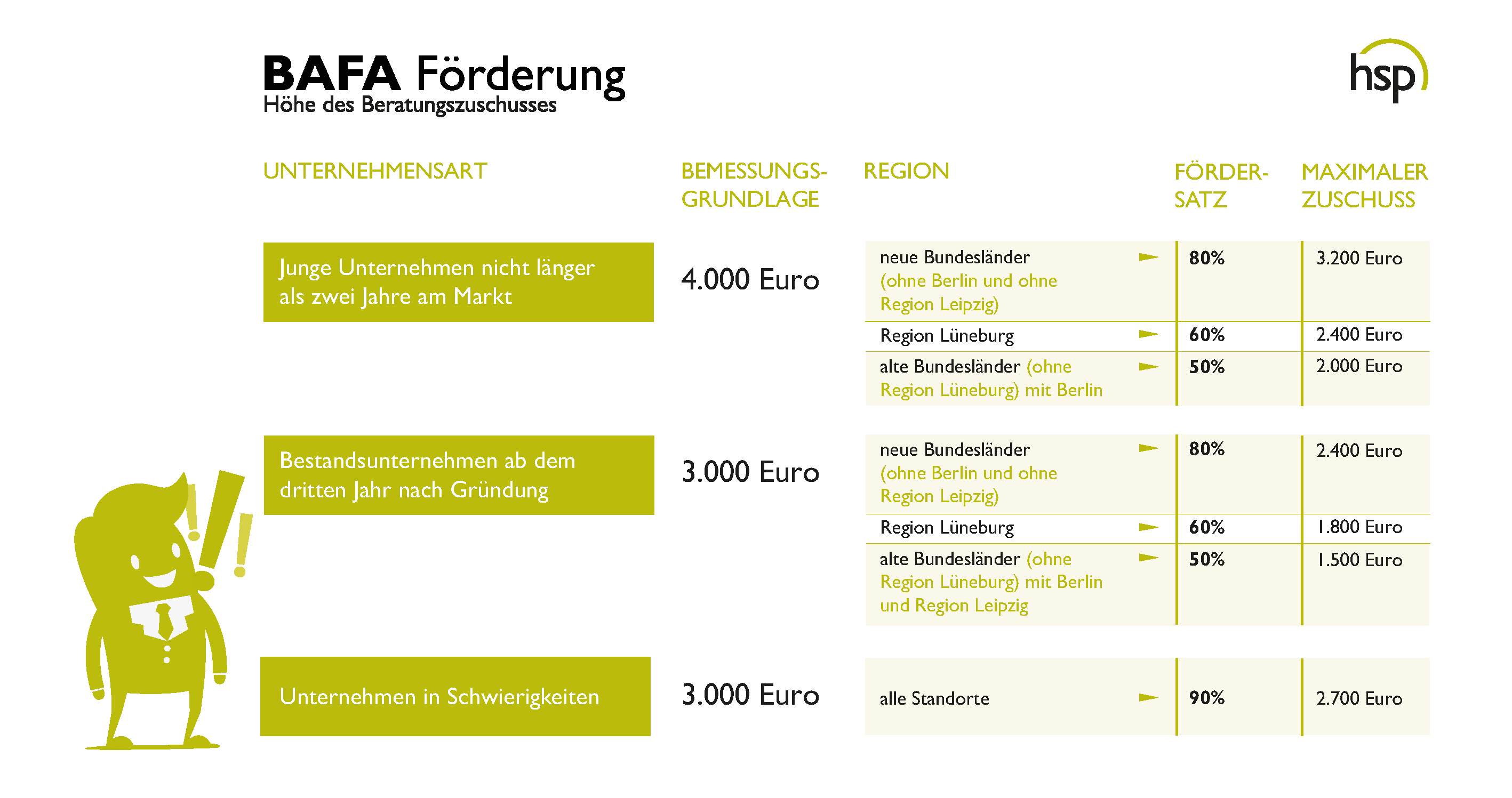
How do these programmes differ from the coronavirus support scheme?
For the programmes aimed at start-ups and businesses in difficulty, you must have a meeting with a BBG regional partner. When you submit your application, the programme will ask for the date of this meeting, so it must have taken place before you submit your application. Therefore, before you submit your application via Opti.Tax, please contact a regional partner. Here you will find a list of the regional partners of the BBG (Federal Business Advisory Service).
What else is eligible for funding under these schemes, compared with the funding scheme for businesses affected by the coronavirus?
In principle, anything that was already eligible for funding under the BAFA’s coronavirus support scheme is eligible for funding.
I would like to convert a COVID-19 grant application I have already created in Opti.Tax to the general grant scheme. How do I do this?
Please ensure that the latest software update is installed (20.1.4 or later). You can then right-click on the project and reset the status to „Preparing for BAFA funding application“. When you reopen the project, you will find an option in the bottom-left corner of the „Consultancy Funding“ section to select ‘No’ under ‘Corona’ in the additional company details.
You must now specify in the newly available field whether the enquiry is for general advice or specialist advice. You also have the option of specifying, under ‘Type of business’, whether the application is for a start-up, an established business or a business in difficulty.
Once you have completed these four steps, you can apply for the BAFA grant in the top-left-hand corner. The relevant form will open, already pre-filled.
What should I do if I purchased an Opti.Tax licence solely on the basis of the BAFA coronavirus support scheme?
The BAFA’s decision to suspend the funding scheme came as a surprise to everyone. As the whole world is currently facing an extreme situation, government measures can change from one day to the next. That is precisely why you made the right choice in opting for Opti.Tax. We update the programme on an ongoing basis in line with developments.
What’s more, you haven’t just purchased a licence – you’ve entered into a productive partnership. This means that we’ll keep you up to date via our social media channels, provide practical advice in regular live streams, and regularly feature interviews with experts. With Opti.Tax, you can significantly expand the range of services you offer your clients. So don’t limit yourself to just one aspect. Make the most of the software in the long term and to its full potential.
Our recommendation: The full discussion on the current situation
Just two days after the BAFA funding scheme was suspended, we spoke to law firm strategist Daniel Terwersche and funding adviser Alexander Thiem during a livestream. During the livestream, the panellists explained the various funding options in more detail, whilst Paul Liese demonstrated the switch to the general funding scheme live within the software. In addition, Terwersche, Thiem and Liese answered questions from the live chat.
What other funding opportunities are available?
The BMWi runs the „go-digital“ programme, which is administered by EURONORM GmbH. The aim of the programme is to promote digitalisation amongst SMEs and the skilled trades sector. The programme comprises three modules: „Digitalised Business Processes“, „Digital Market Expansion“ and ‘IT Security’.
Who is eligible to submit projects for funding under the go-digital scheme?
Only authorised consultancy firms may submit projects. This is a key difference from the BAFA. The authorisation process takes longer (several months), so planning should be long-term. References must be submitted as part of the authorisation process. The reference documents serve as proof of competence and should include projects that are no more than three years old and are, at the very least, largely completed. The company you have advised must not have more than 100 employees, but – unlike the companies whose projects are being submitted for funding – it does not have to be based in Germany.
How does the go-digital funding scheme work?
The consultancy project must meet certain criteria set out in the relevant module. To this end, we recommend that you watch the stream on the topic of ‘go-digital’. Once submitted, it is not uncommon for it to take eight weeks or longer to receive a response. The BAFA carries out only an electronic assessment, whereas with go-digital, a case officer thoroughly reviews the documents submitted. If you receive a positive decision, you can expect your project to be funded upon completion, provided it has been carried out correctly.
Discussion on the end of the BAFA coronavirus support scheme
Just two days after the BAFA funding scheme was suspended, we spoke to legal strategist Daniel Terwersche and funding adviser Alexander Thiem during a livestream. During the livestream, the various funding options were discussed in more detail; Paul Liese demonstrated the switch to the general funding scheme live within the software, and a number of important questions were answered in the live chat.


Discussion on the ‘go-digital’ funding programme
When the BAFA funding scheme for consultancy services for businesses affected by the coronavirus was temporarily suspended, we looked into alternatives. We found ‘go-digital’, which, however, differs in a number of ways from the BAFA programme. Paul Liese spoke once again with funding adviser Alexander Thiem and Daniel Terwersche about the BMWi’s go-digital funding programme.







 German
  English