

Procedure Documentation Templates 2025: Use templates to save a lot of time
The German tax authorities require companies to draw up procedural documentation in accordance with GoBD. Many tax advisers and clients are put off by the amount of work involved in creating procedural documentation in accordance with GoBD from scratch. For such cases, there are sample procedural documentation templates available. These templates can be downloaded and adapted, saving a great deal of time.
Whether you’re a medium-sized business or a small enterprise, sample procedural documentation templates make the work easier. With the right template, tax advisers and their clients can enjoy a number of benefits:
- Save time: With a template, those involved do not have to start from scratch.
- Save money: Less time spent means less effort.
- Orientation: Key performance indicators provide reliable guidance
On paper, the arguments are convincing. But what about in practice? As a user of such templates, how can I find out whether the figures are valid? Who creates these templates – and can I find suitable procedural documentation templates for specific sectors?
Comprehensive documentation is mandatory
Many SMEs regard procedural documentation as a tiresome requirement imposed by the tax authorities. In doing so, they are ignoring a stark and important fact: procedural documentation in accordance with GoBD has been mandatory in Germany for years. Through this documentation, the tax authorities ensure that they have access at all times to the recording, posting, processing, storage and disposal of data and supporting documents.
Companies must therefore make their books, records and documents available in electronic form. Should the authorities carry out an audit and the company be unable to produce the relevant documentation, it faces severe penalties. By introducing this requirement, the tax authorities sought to achieve two things:
- In this way, the authorities wanted to make it clear to businesses just how seriously they take procedural documentation. A requirement is a requirement – and they are now taking decisive action.
- Furthermore, this requirement should encourage companies to gain a better understanding of their own operations and to organise themselves more effectively. A better-structured organisation naturally reduces a company’s risks and weaknesses.
Many companies ignore this obligation
However, the situation in 2020 gives the impression that companies have been virtually paralysed by the threat of penalties. Instead of contacting their tax advisers and accountancy firms to fulfil their obligations, many SMEs would rather ignore the issue. They hope that the spectre of a tax audit will pass them by. But that cannot be the solution.
Particularly because documenting business processes is not just a tedious chore. It is an excellent opportunity to optimise your own business. Large corporations spend many millions of euros commissioning management consultancies to document and optimise their processes. SMEs can simply go to their tax adviser, review their own business together with them, and improve their operations.
Companies benefit enormously from process documentation:
- A detailed insight into your own processes
- Duplicate steps are detected
- Unnecessary efforts are identified
- The workforce’s skills are utilised more effectively
- Risks, such as those arising from staff absences, become apparent
- Controlled growth rather than improvisation
Rather than shying away from a tedious task, businesses should recognise and capitalise on the opportunities. And sample procedural documentation templates make the process of drawing them up much easier. But how exactly can tax advisers and clients make use of such templates?
Using process documentation templates with the right software
Templates for process documentation should not be documents that are printed out and filled in by hand. Instead, consultants should use documentation software that is capable of working with process documentation templates. A forward-thinking software provider supplies these templates as part of the programme itself, thereby ensuring compatibility.
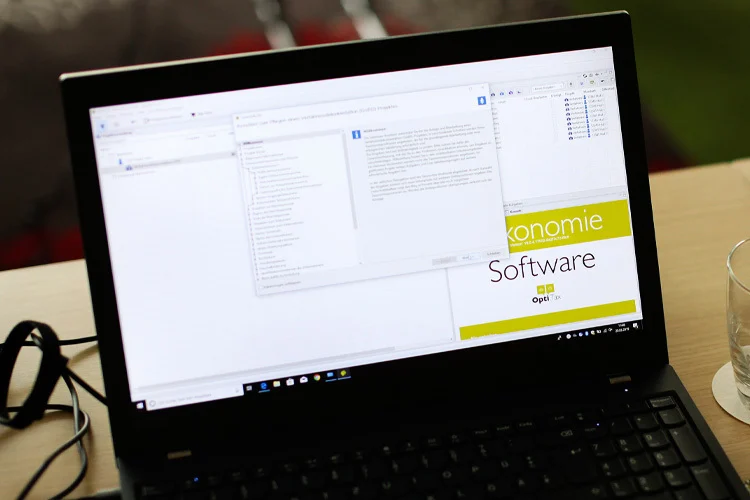
The Hamburg-based software specialist hsp offers this comprehensive solution: Opti.Tax. The taxonomy software in itself makes it easier to create documentation. This is because the user is guided through the programme in a sort of interview format, making the process surprisingly straightforward and intuitive. The process documentation templates provided make things even easier for users.
Sample procedural documentation from financial experts
Sample procedural documentation is only useful if the author can demonstrate the necessary specialist expertise. That is why hsp collaborates with the C4B finance benchmarking platform. Opti.Tax offers its users C4B’s target processes, which have been benchmarked. This means that the sample procedural documentation is fit for purpose.
However, there is no one-size-fits-all solution for the ‘one true’ procedural documentation. Whilst templates can often provide a solid foundation, the processes vary greatly from one taxpayer to another. Depending on the complexity, volume of supporting documents and use of IT, requirements can vary considerably – for example, in terms of the structure of the document filing system and the scope of the documentation. For this reason, every sample procedural documentation can be customised. It serves as a template for companies to document the document filing process using company- and sector-specific details.
Key points for consultants and companies
The scope of procedural documentation varies from case to case. The documentation must make three points clear to an external third party:
- Data processing procedures
- Books and records
- Documents on file
A procedural document describes the process as intended from an organisational and technical perspective. In the case of electronic documents and document archiving, for example, the following points are recorded:
- Origin of the information
- its indexing, processing and storage
- unambiguous retrieval
- machine-readability
- protection against loss and tampering
- reproduction
The Procedural documentation usually consists of a general description, user documentation, technical system documentation and operational documentation.
Consultants and companies must take different factors into account when approaching process documentation. Consultants should prioritise the most productive tool. Which software enables its users to work efficiently? Which provider offers particular support to consultants with special requests, specific requirements or changes in legislation? Companies, on the other hand, should consider the approach the consultant takes to creating procedural documentation. A structured, collaborative approach, together with the ongoing maintenance of the documentation, are indicators of reliable, long-term consultancy.
The first step towards exemplary Procedural documentation
Why it is worth investing in process documentation templates
For some time now, the German Association of Tax Advisers (Deutscher Steuerberaterverband e.V.) has been providing taxpayers and their advisers with a very simple template. This template covers the topic of digital document storage. Users can download the sample procedural documentation as a PDF from the association’s website. The document must then be completed step by step.
This is where consultants and business owners alike are quite rightly asking themselves: is this the best possible technical solution in 2020? The software developer hsp offers a modern answer to this question. Opti.Tax works with taxonomies. Users are guided step by step through the documentation. The programme automatically checks whether the information is consistent and complete. Users do not have to type out lengthy texts; instead, the software generates the finished procedural documentation from the details entered.
Select, download and edit the appropriate process documentation template
Opti.Tax provides users with comprehensive sample procedural documentation. This currently covers more than 20 standard business processes. These include processes from the following areas:
- Payroll
- Financial Accounting
- Sales
- Production
In addition, tax advisers can provide their clients with checklists to help them prepare procedural documentation. Once the client has completed the checklists, the tax adviser can import the results into Opti.Tax with just a few clicks. The software fills in all the fields automatically.
Software plus templates equals efficiency
These days, companies cannot and must not assume that the tax authorities will turn a blind eye to everything. Before an audit takes place, they should have drawn up procedural documentation. With Opti.Tax, hsp offers a simple, comprehensive software solution. It includes sample procedural documentation from a wide range of sectors, all of which are practical and customisable.
hsp has been operating successfully in the market since 1991. So, anyone who chooses hsp can plan for the long term. The same applies to the software: regular updates and adjustments take account of legal requirements, current issues and customer requests. New templates for procedural documentation are added on an ongoing basis – at no extra cost. If they have any questions, users can contact the hsp community or the support team.
An investment that pays off
Templates for procedural documentation save a lot of time – provided the templates are digital and can be customised using software. Would you like to find out more about Opti.Tax, find out about the templates included and the options available? Please feel free to contact hsp with no obligation:







 German
  English