

Offer digital transformation consultancy, build client loyalty
Offer digitalisation consultancy, build client loyalty
Academic-level e-learning
Tax consultancy firms must diversify their operations and tap into new areas of business to prepare for the future. This is because an increasing number of providers are working on automation, putting pressure on the tax consultancy sector.
Digitalisation is a lucrative sector with great revenue potential. After all, more and more companies are currently looking to digitise their processes. However, many are reluctant to entrust their internal data and processes to management consultancies they know nothing about.
Your clients, on the other hand, already trust you. This is your opportunity.
Make the most of your trust advantage
You know your clients’ processes better than anyone. Who could be better suited to their digital transformation than you? The ‘Digital Transformation Consultancy’ training course will equip you or your team with the skills you need over a total of more than 100 hours the full range of expertise required to provide comprehensive advice and support to businesses as they undergo digital transformation.
Structure and content
Structure and content
The ‘Digitalisation Consultancy’ continuing professional development course provides tried-and-tested knowledge with an unprecedented breadth and depth. Flexible e-learning spanning numerous hours, plus at least 54 hours of live coaching, 10 hours for supervised projects carried out in collaboration with your clients, and virtual classrooms for constant contact with the module leaders – this is currently only available at the hsp Academy.
Module 1:
GoBD
The GoBD as the basis for digitalisation consultancy
Most tax practice firms are familiar with the GoBD framework, but many are not yet fully aware of its significance. In many places, compliance requirements such as version control and the archiving of data and processes have not yet been implemented.
From an accounting perspective, the GoBD is one of the fundamental building blocks. In particular, the entire system must be structured in a manner that complies with the law. The GoBD module of the ‘Digitalisation Consultancy’ further training course provides the knowledge required to meet the GoBD requirements beyond reproach.
Step by step, the module covers the topic of GoBD in 25 structured lessons. The principles are examined in depth, from the background and introduction right through to detailed questions. The course is rounded off by putting what has been learnt into practice.
Your lecturer
Carola Zimbrich
Consultant, WEFORM Consulting GmbH. Trained as a legal and notarial assistant and holds a degree in business administration; has been a consultant in the field of digital accounting since 2017 and in the field of GoBD since 2018. Find out more.
Your lecturer
Raphael Kammer

Managing Partner, WEFORM Consulting GmbH. A qualified lawyer and business graduate with many years’ experience in management consultancy and tax consultancy. Founded WEFORM Consulting GmbH in 2018, specialising in law firms. Find out more.
Module 2:
Process modelling
Process modelling in digital transformation consultancy
In order to identify which processes can be optimised through digital solutions, the workflows must first be mapped out. Ideally, this is done using a process model, which provides a clear overview of a company’s processes.
However, it is not just a matter of documenting the processes. The people involved must also be identified. The Process Visualisation and Process Modelling module teaches you how to create useful, relevant process models and interpret them correctly.
Process modelling using BPMN is explained in clearly structured lessons. From an introduction through to in-depth study and implementation, the module covers all the necessary steps.
Your lecturer
Torsten Busse-Stein

Managing Director, bsp business solution professional GmbH. Studied Accounting, Management Accounting and Business Logistics; 20 years’ experience in areas including bookkeeping and accounting. Find out more.
Module 3:
sales training
Successful marketing of digitalisation consultancy services
Before tax practice firms can get started with digitalisation consultancy and process optimisation, they need to conduct a sales pitch. This is an unfamiliar situation, as it is usually the clients who approach you – not the other way round. This is where the ‘Sales’ e-learning module comes in.
This course teaches you how an authentic approach can lead to successful sales. You don’t need to be a sales expert to do this. Strategies and practical advice are explained step by step. After all, if you communicate the benefits effectively, there’s usually no need for a discussion about price afterwards.
This comprehensive module offers four hours of e-learning. The module starts quite simply with the basics, so that you can build on your knowledge from lesson to lesson and develop into a sales professional. As you progress, you’ll learn questioning techniques and strategies, and will eventually be able to turn your knowledge into actual sales.
Your lecturer
Wolfgang Steffen

Trainer, founder and partner at the Hamburg Training Institute. Decades of experience as a sales and marketing manager; since 1997, a success coach specialising in sales, and a sought-after expert. Find out more.
Module 4:
Compact moderation training
Facilitation training for digital transformation consultancy
In the course of your consultancy work, you will find yourself in situations where you need to facilitate a group. The ‘Compact Facilitation Training’ module is designed to prepare you perfectly for precisely these kinds of situations.
In group settings, you can generate enthusiasm through effective communication, thereby having a significant impact on productivity. Learn the right techniques to manage group dynamics and achieve your goals.
Lecturer Wolfgang Steffen has developed a relatively concise module to cover the key aspects of facilitation. Nevertheless, more than 30 topics are covered to ensure that this valuable knowledge can be successfully applied in practice.
Your lecturer
Wolfgang Steffen
Trainer, founder and partner at the Hamburg Training Institute. Decades of experience as a sales and marketing manager; since 1997, a success coach specialising in sales, and a sought-after expert. Find out more.
Module 5:
Privacy Policy
Digitalisation and the GDPR
The introduction of the General Data Protection Regulation (GDPR) in 2018 sent shockwaves through the digital world. Whether in online retail, the media sector or medical practices, people were suddenly presented with countless forms to sign everywhere they turned. The term ‘data protection’ no longer sounded consumer-friendly, but rather complex and risky.
The ‘Data Protection’ module within the ‘Digitalisation Consultancy’ course dispels these preconceptions. This is because myths and misconceptions not only hinder the development of new processes, but can also lead to costly mistakes and detours.
What issues need to be addressed? This question is examined from both the company’s perspective and that of the employees. The module clearly explains how data protection can be implemented without too much effort.
Your lecturer
Hendrik Sievers

Partner and specialist solicitor in IT law at beck rechtsanwälte. TÜV-certified external data protection officer with a passion for technology and digitalisation; data protection and GDPR expert. Find out more.
Module 6:
Internal Control System
Internal Control Systems in Digitalisation Consultancy
When it comes to the internal control system – or ICS for short – the focus is on the question: intent or negligence? If the tax authorities uncover an error, they are particularly interested in whether it was a deliberate act or merely an oversight. With a functioning ICS, the company mitigates risks and the authorities are more likely to rule in the company’s favour.
The ICS module provides a comprehensive and engaging introduction to the subject of internal control systems. The course begins by covering the fundamentals, making it easier for learners to get started. It then moves on to a detailed examination of the topic of risk. Following this, the module delves into the intricacies of the ICS, covering all its components, possibilities, advantages and disadvantages.
This also covers topics such as legal matters, ICS documentation and the fees charged by ICS consultants. Naturally, this module also ensures that the knowledge acquired is put into practice.
Your lecturer
Viktor Rebant

Consultant for Internal Control Systems, Innotax GmbH. Qualified tax clerk; studied tax law; responsible for the Internal Control Systems (ICS) division since 2018; also studied IT management. Find out more.
Module 7:
Automation
Process automation: low-code & no-code
Repetitive tasks within a business, in particular, can usually be automated. Nevertheless, many people are reluctant to tackle the subject of automation. This is because it raises questions such as: Can I automate processes at all without any programming knowledge? How do I get started with automation in my company? What options are available, and how much real added value does it offer?
Sebastian Mertens is an expert in the automation of business processes. In his e-learning course, he shares practical knowledge about automation using various tools. The low-code/no-code approach requires no programming skills, which makes it particularly easy to get started.
Your lecturer
Sebastian Mertens

Co-founder and CEO of wemakefuture GmbH, a pioneer in the field of cloud-based process automation. Find out more.
Module 8:
Value-added documentation
The preparation of value-added documentation
Once the process model has been created, the question arises: what are the next steps required to generate added value for a law firm or a company from the modelling?
This module, „Creating value-added documentation based on process modelling in digitalisation consultancy“, provides a detailed answer to this question. It focuses on creating process documentation that delivers genuine added value.
From an introduction to process documentation through to the partially automated creation of documentation, you will gain both theoretical and practical knowledge.
Your lecturer
Eugen Müller

Tax adviser and partner at Müller Blum Steuerberatungsgesellschaft mbH. Studied economics (BA, LLM), with experience in tax consultancy and at AUDI. Founded his own practice, which he now runs jointly with Timo Blum. Find out more
Take advantage of the FAIT qualification as a bonus
Take advantage of the FAIT qualification as a bonus
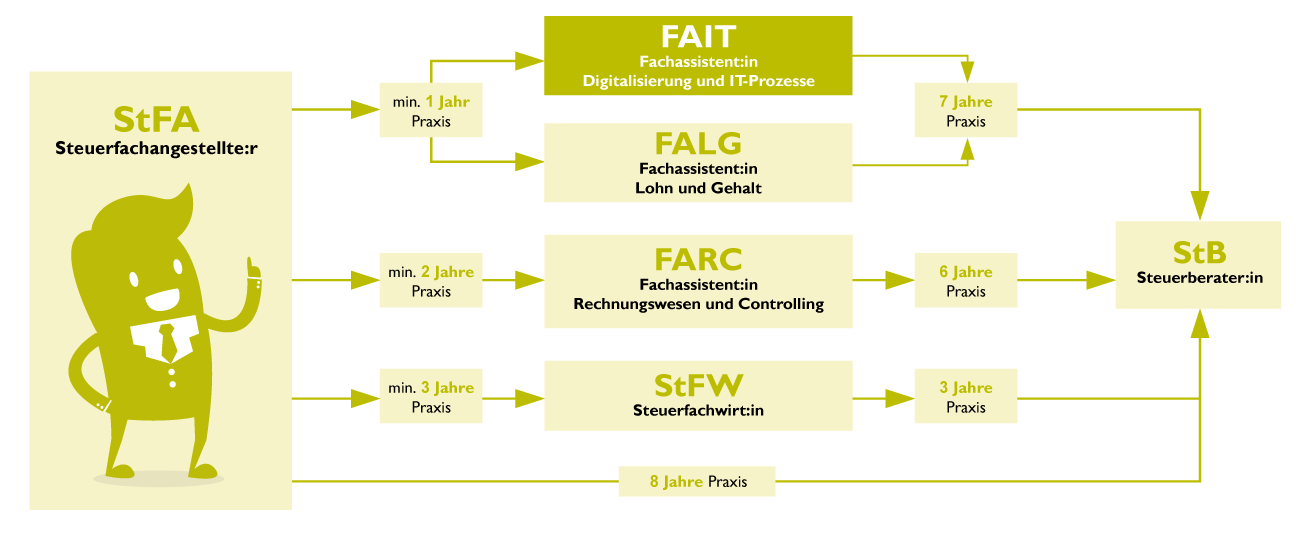
New qualification: Specialist Assistant in Digitalisation and IT Processes
- Analysis, standardisation and automation of digital processes within the law firm and for clients
- Supporting the law firm with its digital strategy
- Providing technical support to law firm staff with regard to digital work processes
- Organisation of cooperation between the law firm, clients and third parties
- Advising clients on the selection of software, interfaces and service providers
- Implementation of data protection regulations and data security
Ready for the FAIT exam – and for real-world projects
The ‘Digitalisation Consultancy’ continuing professional development course includes not only the current modules but also all future ones. Leading FAIT experts are currently developing further e-learning modules to cover all examination topics.
Consequently, this course provides far more specialist knowledge than is required for the FAIT examination. This ensures that the material you learn does not remain mere theory, but instead leads to real projects for the firm in the near future.
Entry requirements for the FAIT examination:
- Upon successful completion of the tax clerk examination: 1 year’s practical experience
- Upon completion of a 3-year university degree: 1 year’s practical experience
- If you have completed equivalent vocational training: 2 years’ practical experience
- Without relevant vocational training: 3 years’ practical experience
- In addition, authorisation may be granted in exceptional cases
Book now and get started
Book now and get started
Introduce digitalisation consultancy services to your tax practice or law firm today. Simply fill in the form below.







 German
  English