


Comparative market analysis in transfer pricing: preparing transfer pricing documentation, but in a more relaxed way
The tax authorities’ requirements for transfer pricing documentation are now stricter than ever. Affected companies are urged to treat transfer pricing as a top priority. However, preparing procedural documentation requires thorough preparation, for example by using the right tools and resources. The company smartZebra specialises in the area of arm’s length comparisons within transfer pricing documentation.
We spoke to Daniel Dinnebier, Director of Transfer Pricing at smartZebra. He highlights the importance of arm’s-length comparables and outlines the latest developments in the field of arm’s-length comparisons for transfer pricing.

What does the arm’s length principle mean in the context of transfer pricing documentation?
In transfer pricing documentation, it is essential to demonstrate that transactions are at arm’s length. This means that companies must be able to provide comparable market values. The requirements of the tax authorities clearly stipulate this. In practice, this involves a great deal of work, as the figures must be laboriously collected on a case-by-case basis and entered into the documentation without error. Furthermore, companies are often uncertain as to whether the arm’s-length comparisons will stand up to scrutiny by the tax authorities.
Daniel Dinnebier was aware of this challenge and aims to provide a solution with the smartZebra service. This is because the usual approach not only consumes time and resources, but is also prone to errors and can ultimately cost a great deal of money. To drastically simplify arm’s-length comparisons, Daniel’s service contains data on 30,000 companies worldwide, including realistic EBIT and EBITDA margins, which are crucial for documentation purposes.

Reliable data available quickly
This data is not only important for preparing transfer pricing documentation, but also for making timely adjustments to service relationships and agreements within a company. Access to this data enables companies to better understand market conditions and adjust their pricing accordingly.
One of the questions that frequently arises is whether the data in the smartZebra database is up to date. Dinnebier emphasises that the data is generally very up to date, particularly the interest rates, which are updated monthly. This is crucial, as companies are often under time pressure to prepare their transfer pricing documentation by the deadline.
The challenge is that the latest annual accounts, which are necessary for collecting this data, are sometimes unavailable. Nevertheless, the availability of historical data dating back to 2010 is a major advantage, as it enables companies to analyse past market conditions.
The new transaction matrix does not replace the full documentation
Another important issue is the introduction of the new transaction matrix, which is intended to serve as a simplified form of transfer pricing documentation. This matrix enables companies to present the structure of their intra-group transactions clearly and concisely. Dinnebier points out, however, that this does not replace the full documentation requirement, which remains in force.
The transaction matrix includes basic information such as the type of transaction and the volume; however, detailed documentation of the pricing and the methods used remains essential. The smartZebra database provides valuable support here in determining the necessary comparative figures.
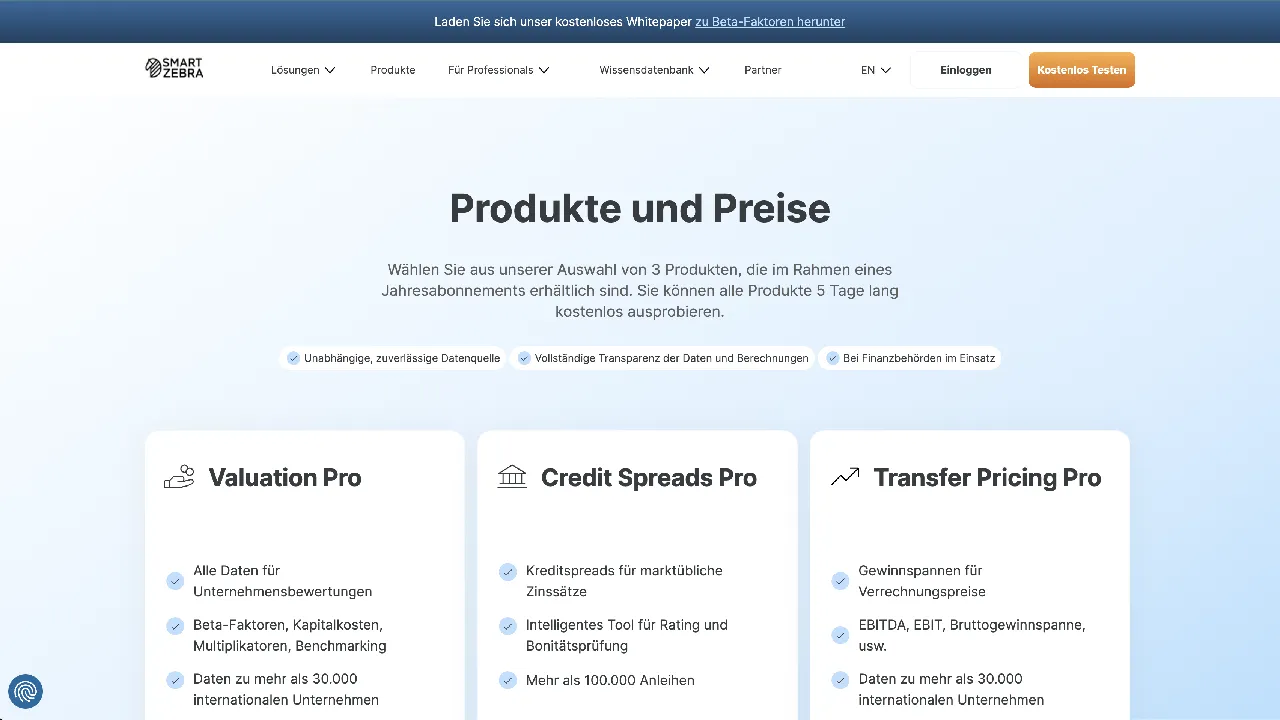
Anyone interested can find all the information and products they need on the smartZebra website.
Comparisons with third parties in transfer pricing documentation are of paramount importance during tax audits
Tax audits are a matter of great importance to businesses. Dinnebier shares anecdotes from clients who report that audits have become more rigorous. The tax authorities appear to be searching more actively for errors, which means that businesses need to be better prepared to meet their documentation requirements.
It is important to have comprehensive documentation in order to prevent any potential enquiries or additional assessments by the tax authorities. Using the smartZebra database can help to strengthen this documentation and make businesses less vulnerable to scrutiny.
Personal recommendations from Daniel Dinnebier
Finally, Dinnebier offers personal recommendations for companies wishing to optimise their transfer pricing documentation. He advises that the documentation be prepared in close conjunction with the annual accounts to ensure the data remains up to date. Furthermore, companies should make active use of the smartZebra database to review and validate their pricing and documentation.












 German
  English