


The Digital Financial Report – or DiFin for short – is an initiative from the financial sector for the electronic submission of annual accounts and other financial reports. We explain what it’s all about.
This procedure marks the start of an efficient exchange of information between reporting companies and their banks and building societies. Banks and building societies are legally obliged to ensure that their borrowers disclose their financial circumstances. Companies wishing to take out a loan, or which have already done so, must therefore submit their annual accounts to their bank or building society, which analyses the accounts and uses them as the basis for the credit assessment.
The Financial Report: Then and Now
Previous procedure
To date, the submission of annual accounts has involved a process heavily reliant on manual work, which is no longer appropriate for the times: the company, or its tax adviser or auditor, prepares and processes the accounts using IT. These financial statement documents are then printed out and sent in paper form to the bank or building society, where the data is entered manually into the IT system used there for analysing the financial statements. This is cumbersome, time-consuming and costly, prone to errors, leads to unnecessary queries and is no longer appropriate in an age of digital communication.
Digital Financial Reporting Process
The digital financial reporting process is based on the XBRL taxonomy – which is already well-established and proven from its use in electronic tax returns – and utilises the existing technical infrastructure for this purpose. The seamless transfer of financial statement data reduces the administrative burden, process costs and time spent for all parties involved; it minimises the risk of errors and thereby improves data quality.
A significant part of the lending process can be speeded up and risk assessment improved. Since April 2018, banks and IT service providers have been adapting their processes and applications to the new, nationwide standard known as the „Digital Financial Report“.
Digital financial reporting is here – we have the right software for you
Following in the footsteps of the tax authorities, financial institutions have now also recognised the potential of digital solutions. Whilst the electronic balance sheet Having already developed in recent years into a mass process involving several million submissions of digital annual accounts each year, the banking sector now also wishes to jump on the bandwagon. Until now, companies or their tax advisers have predominantly forwarded annual accounts to banks and savings banks in printed form or as PDFs. There, these are entered manually so that they can be recognised by the banks„ and savings banks“ own analysis systems. The ‘Digital Financial Report’ (DiFin) is intended to prevent this change in media format in future by transmitting the data in XBRL format. The banking sector expects this to result in time and cost savings, whilst companies can look forward to faster credit decisions.
The digital financial report does not give rise to any additional liability risks for tax advisers. By issuing the liability clarification statement, banks and building societies make it legally clear that, in the case of electronic transmission, advisers are not placed in a worse position than if they had handed the financial statements to their clients in paper form for submission to the bank or building society. A bank or building society may only participate in the process once it has submitted the liability clarification statement. Furthermore, the client confirms to their bank the binding nature of the digitally transmitted annual accounts by means of the so-called Declaration of Participation and Liability (TVE).
It has been possible to submit the first digital financial reports since April 2018. At present, however, not all software providers – and only a small proportion of banks and savings banks – are yet in a position to take part in this project. This is precisely where we, as a software manufacturer, come in with our solution Opti.Tax.Docs in question.
How does Opti.Tax Doku work?
Opti.Tax Doku generates the annual accounts on a taxonomy-based basis in XBRL format, the international standard for digital reporting of financial, performance, risk and compliance information. This means that the annual accounts can be transmitted entirely electronically without any media discontinuity. You simply need to take into account the requirements of the receiving interfaces: the e-balance sheet for the tax authorities, disclosure and filing for the Federal Gazette, and the digital financial report for the banking sector. The user-friendly posting system, clear trial balances and reconciliation views provide efficient support for your year-end closing work. Using the familiar functions of Office.Filer, you can update the taxonomy-based values easily and directly. You can export balance sheet reports and distribute them in your company’s own layout.
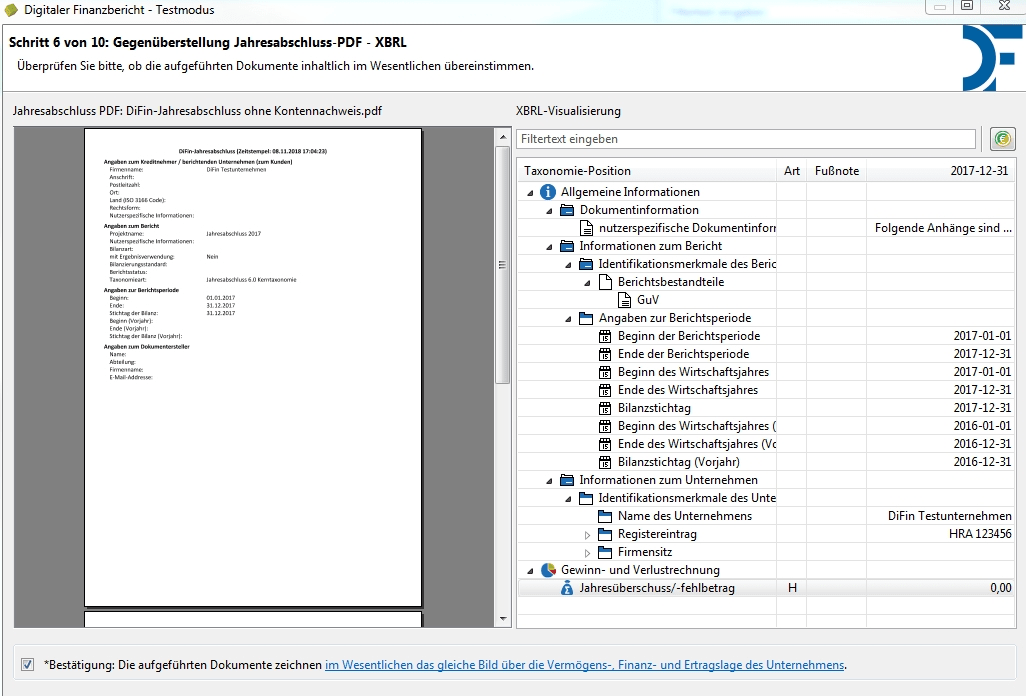
Please find attached a screenshot of our DiFin implementation – with no personal data included.
Interested?
Further information on DiFin can be found on the website of the Association of Tax Advisers or on our Topic page.












 German
  English