


How a law firm benefits from drawing up a contingency plan with a client
What you can expect from this article
At first glance, estate planning is a subject that many clients tend to put off. It is often associated with emergencies – such as illness, accidents or death – in other words, precisely the issues that hardly anyone wants to think about in their day-to-day lives. Yet it is precisely this emotional distance that makes the estate planning dossier such a valuable tool for tax practice firms. After all, those who guide their clients through this process in a structured manner not only create order and security, but also open up a whole new level of advisory service.
Essentially, the purpose of the estate planning file is to bring together all of a client’s relevant information in one place. This includes assets, property, shareholdings, bank details and insurance policies, as well as personal arrangements such as powers of attorney or living wills. What initially appears to be a purely administrative task turns out, in practice, to be a strategic starting point for comprehensive advice. It is only through this complete transparency that an overall picture emerges which goes far beyond what is apparent in traditional tax processes.
From reactive to proactive advice
Many law firms operate on a largely ad hoc basis in their day-to-day work. There is a specific issue, a tax matter or a statutory deadline – and they respond to it. Whilst strategic advice is provided, it often remains limited to individual cases. The reason is rarely a lack of expertise, but rather a lack of data.
The wealth management dossier fundamentally changes this initial situation. By bringing together all the relevant information, it creates a new level of quality for the basis of discussion. Suddenly, it becomes clear how assets are structured, where the risks lie and which issues have so far been overlooked. For the firm, this represents a shift in perspective. Rather than reacting to individual issues, the firm now provides proactive advice that generates targeted ideas.
This brings about a noticeable change in the conversation with the client: less focus on coming to terms with the past, and more on shaping the future. This is precisely where one of the greatest economic benefits lies: advice is no longer provided haphazardly, but systematically.
Property as a starting point for creating added value
Property provides a particularly clear example of this potential. In many cases, clients own several properties that have been acquired over a period of years or decades. However, there is often a lack of an overarching perspective. Each property is considered, treated for tax purposes and managed in its own right – but rarely as part of an overall strategy.
It is only the estate planning file that brings this overall picture into focus. The law firm can see how many properties there are, how they are financed and how they relate to one another. This immediately raises new questions. Is the current structure sensible in the long term? Are there any tax advantages to be had? How can the client arrange for the transfer to the next generation?
Such questions do not arise artificially, but follow logically from the new level of transparency. This opens up a new area of consultancy for the firm that goes far beyond day-to-day reporting. It involves strategic decisions and providing closer support to clients.
Company assets and succession as a key area of advice
The effect is even more pronounced among business owners and shareholders. In these cases, the pension planning process is often the first occasion on which all the relevant information is compiled in full. Shareholdings, company structures and personal pension arrangements are suddenly laid out side by side, allowing them to be considered together for the first time.
Clients are finally realising that key issues have so far remained unresolved. Business succession is unclear, powers of attorney are either missing or out of date, and the tax implications of a handover have not yet been properly considered. This presents law firms with an opportunity to provide a genuine advisory service.
The estate planning file provides an opportunity to actively address these issues. It establishes an objective basis on which even sensitive matters can be discussed in a structured and transparent manner. It becomes clear to the client that action is required, and the firm is given a clear mandate to provide support.
The pension planning file as an ongoing advisory process
One crucial point is often underestimated: the pension plan is not a static document. Its effectiveness depends on it being regularly updated and adapted. Financial circumstances change, new investments are made, and family situations evolve. What is up to date today may well be out of date in just a few years’ time.
This is precisely where a further commercial advantage for the firm lies. The pension planning file is not simply drawn up and then filed away, but evolves into an ongoing process. Regular reviews and updates provide new opportunities for discussion and ensure that the firm maintains a close relationship with its clients over the long term.
This continuity leads to a more stable client relationship and to consultancy services that can be planned effectively. Rather than one-off projects, a recurring dialogue develops, which pays off both professionally and financially.
Market differentiation and stronger client loyalty
In addition to the direct revenue potential, the estate planning file also has a strategic dimension. It changes the role of the law firm in its relationship with the client. A firm that supports its clients in drawing up and maintaining an estate planning file transforms itself from a mere service provider into a trusted adviser on key life issues.
This position is of great importance in the market. Standardised services are increasingly being automated and are becoming more comparable. The difference lies in areas where individual advice and personal relationships take centre stage. The pension plan is an ideal tool for achieving precisely that.
At the same time, the client’s loyalty to the firm grows. Anyone who has worked with the firm to build up a comprehensive overview of their financial and personal circumstances will not give that up lightly. This raises the barrier to switching, as the knowledge and structure that have been built up cannot be easily transferred.
 Digital emergency files: the software solution that can save businesses
In the latest January episode of „hsp live at 11“, Paul Liese, Managing Director of hsp, spoke to Andreas Gaebler, head of the process consultancy team at the law firm Schröder & Partner (Berlin and Stendal), about a fascinating topic: the digital emergency file.
 Another file? How the pension file puts files to rest
There are many things in life that make you think: „I definitely need more of that.“ Holidays, for example. Or coffee. Perhaps Wi-Fi on the train, too. And then there are things that instantly make you think the opposite. Right at the top of this list: files. And, as we all know, Germany has a special relationship with files. There are personnel files, tax files, medical records, building plans, The X-Files and probably, somewhere, a file about your files.
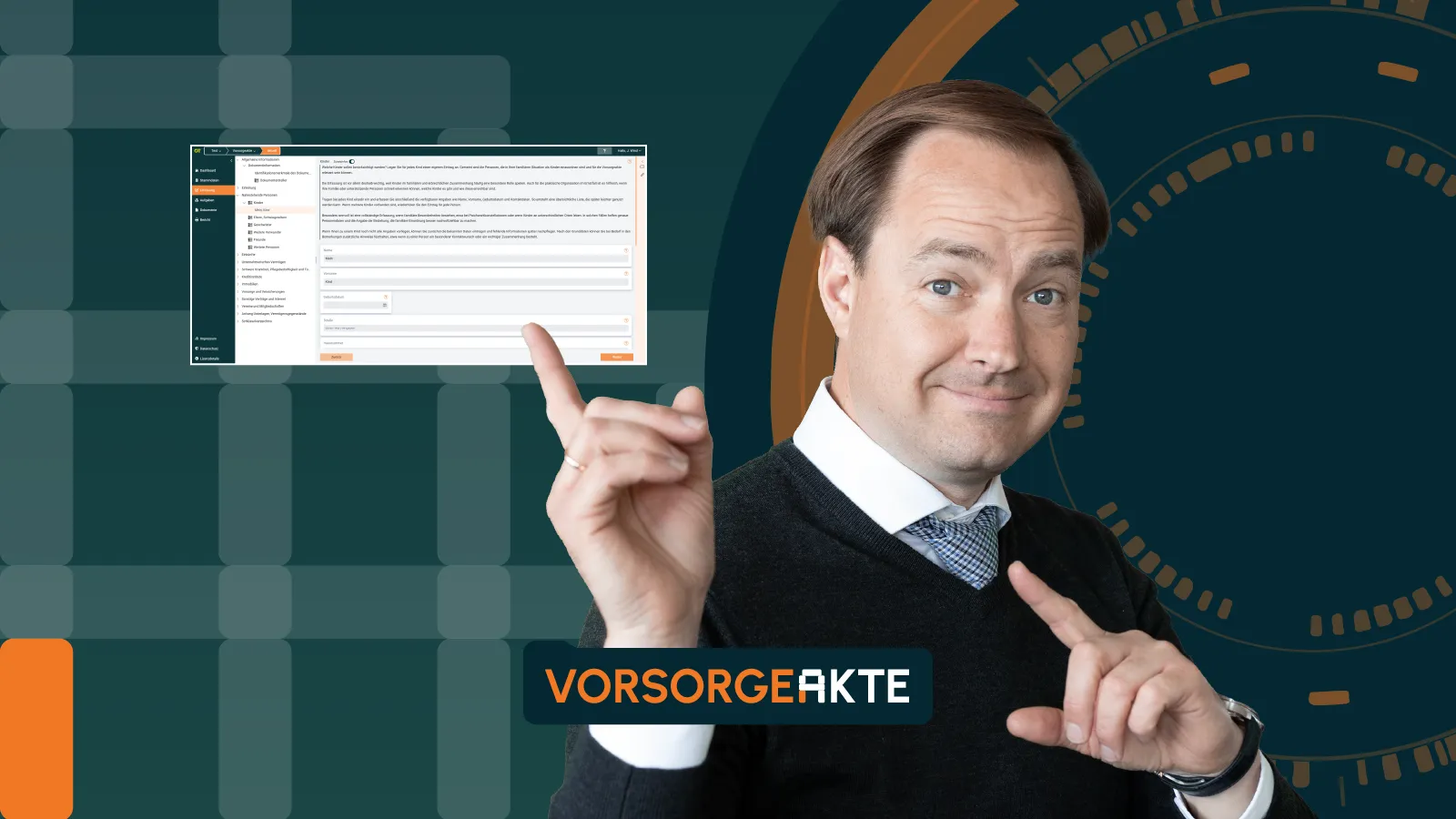 The pension plan as cloud-based software: protecting employees, families and businesses
With its new software solution for digital pension files, hsp offers a 100 per cent cloud-based software package. This means that the software runs entirely on a cloud server. Consequently, users no longer need to install anything on their computers. Furthermore, the digital will and estate planning software works in almost any standard browser, regardless of the operating system.







 German
  English