


The pension plan as cloud-based software: protecting employees, families and businesses
What you can expect from this article
With its new software solution for digital pension files, hsp offers a 100 per cent cloud-based software package. This means that the software runs entirely on a cloud server. Consequently, users no longer need to install anything on their computers. Furthermore, the pension planning file software works in almost any standard browser, regardless of the operating system. During the live broadcast „hsp live at 11“, hsp Managing Director Paul Liese presented a number of exciting new features. These include the cloud interface and the way in which master data is managed. In the second part of the programme, he then introduced the pension planning file.
Opti.Tax is becoming a cloud platform
More and more companies want their software solutions to be hosted in the cloud. With major providers such as Microsoft, most tools are available as cloud solutions. However, for some time now we have all seen just how vulnerable many cloud solutions are. This is particularly the case when they are hosted on servers belonging to large US hosting providers. Outages there affect all services hosted on those servers. This often triggers a chain reaction, as many services are interdependent. As soon as one link in the chain is hosted on a failed server, the entire chain breaks down.
This scenario applies not only to the cloud itself, but also to the purpose of a contingency plan. In this context, the weak link in the chain is the person who fails, throwing all processes and procedures into disarray. But more on that later. First and foremost, hsp prioritises the security of its services. Even with a Word document or a PowerPoint presentation, system failures and data leaks are critical. However, Opti.Tax users handle highly sensitive data, which is on a completely different level. It would therefore be irresponsible of hsp to upload a half-baked, rushed software solution to the cloud. That is why the development department prioritises not only software quality, but also security and data protection. All data is stored on German servers belonging to a German provider, protected by the strictest EU laws and holding multiple certifications.
Safety first, then innovation
During the live broadcast, Paul Liese first shows the new provisional login screen featuring the new Opti.Tax logo. There are two login forms: one for the administrator and one for users with a Microsoft 365 account. For the demonstration, Paul selects the user login. He is first taken to the dashboard – the overview displaying the most important parameters and information from the cloud. Users can customise which information they wish to see; to do this, they can add their preferred widgets to their dashboards as they see fit.
Master data management is a new feature. This is because the master data is decoupled from the project types and effectively forms a project in its own right. All projects draw on this master data, which significantly simplifies maintenance. In addition, the new cloud system uses what is known as a ‘validity date’. Each entry in the master data is assigned a fixed time period. Paul demonstrates this in the livestream using the address as an example. A company is based at Notkestraße from 2011 to 2021 and then moves to Musterstraße. Accordingly, 2011 is entered as the validity date for Notkestraße. This entry remains valid until an entry with a more recent validity date is made: Musterstraße with the date 2021. If the user now edits a project type for 2020, Notkestraße is automatically used as the valid address. This principle reduces both the workload and the potential for errors.
A new approach to master data management
Users can see which project type is currently active at the top of the navigation path (known as „breadcrumbs“, a feature familiar from many websites). All project types are listed in this project type overview. In the demo, Paul now selects the „Master Data“ project type and can then create a new project type: a pension scheme. Part 2 of the livestream picks up straight away: the new project type has been created and is immediately activated, as can be seen at the top of the navigation path. You can now see the „Master Data“ option in the menu on the left, which allows you to view the data as at the selected validity date. To edit the data, however, users must return to the central ‘Master Data’ project type.
Using the „Data Entry“ menu option, Paul opens the taxonomy’s link rolls – that is, the individual report components. In the Windows version of Opti.Tax, these were displayed in the bottom-left corner; in future, they will be clearly laid out in a modern design as a second menu bar, directly next to the main menu bar. Paul then demonstrates the many possibilities offered by the digital end-of-life planning file in the cloud, such as the ability to import bulk data or attach references to individual items. References can be documents, such as a birth certificate or a lasting power of attorney, but can also be explanatory notes.
Lots of clever innovations everywhere you look
Another very handy feature is the ability to send tasks directly from individual positions, for example to request documents or information from third parties. As soon as references are attached to a position, the field is marked accordingly. As in the Windows version, users can also send a Cloud-Interview to third parties here, for example to clients. With just a few clicks, you select the items for which you require information from the client, add a message, and you’re done. Under the „Tasks“ menu item, an overview displays all tasks and their statuses. Good to know: as soon as the user enters further data, the client can see it straight away and knows which positions have already been filled. This function will not yet play a major role in the pension planning file, but it will be important for future project types such as e-balance sheets, CbCR and Pillar 2.
The „Documents“ menu item clearly displays all attached documents. This makes it easier to find important documents „at a glance“. Last but not least, Paul highlights the „Report“ menu item. Here, users can easily specify which components should be included in the report. The cloud software then indicates which components contain entries. Anyone who has registered a DeepL key can have the report generated in any available language. In addition, the software offers further configuration options, such as the extent to which references should be included, or whether stored login details should be displayed in plain text or not.
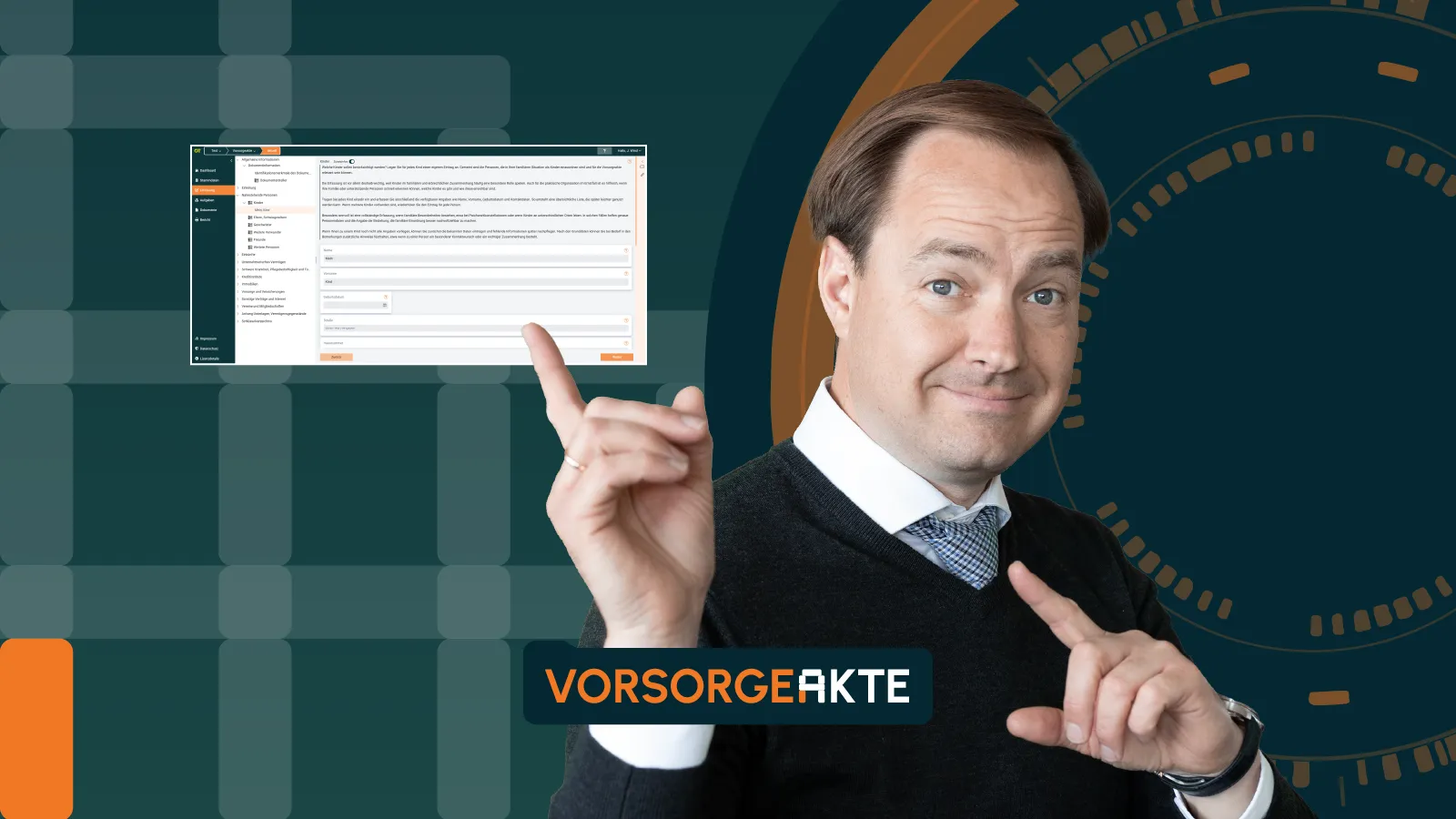 The pension plan as cloud-based software: protecting employees, families and businesses
With its new software solution for digital pension files, hsp offers a 100 per cent cloud-based software package. This means that the software runs entirely on a cloud server. Consequently, users no longer need to install anything on their computers. Furthermore, the digital will and estate planning software works in almost any standard browser, regardless of the operating system.
 Why every family needs an estate planning file
In everyday life, a lot of things just work. Bills get paid, insurance policies run in the background, and important documents are tucked away somewhere in folders, drawers or digital storage. You have a rough idea of where things are. And if not, you’ll find them one way or another. However, it is precisely this „one way or another“ that is the problem. Because as long as nothing goes wrong, it’s hard to notice just how unstructured much of our information actually is.
 How a law firm benefits from drawing up a contingency plan with a client
At first glance, estate planning is a subject that many clients are keen to put off. It is often associated with emergencies – such as illness, accident or death – in other words, precisely the issues that hardly anyone wants to deal with in their day-to-day lives. Yet it is precisely this emotional distance that makes the estate planning file such a valuable tool for tax practice firms.







 German
  English