


One Procedural documentation is mandatory during a tax audit. Nevertheless, this should be the very last reason for producing proper procedural documentation in accordance with GoBD. After all, the auditors couldn’t care less whether documentation is available – if it is, great; if not, there’ll be trouble. The purpose of procedural documentation is for companies to benefit from it and improve their position. This, in turn, naturally benefits tax consultancy firms. The specific added value this entails, and how procedural documentation can help companies during the coronavirus crisis, became clear during the panel discussion at the virtual StB Expo 2021.
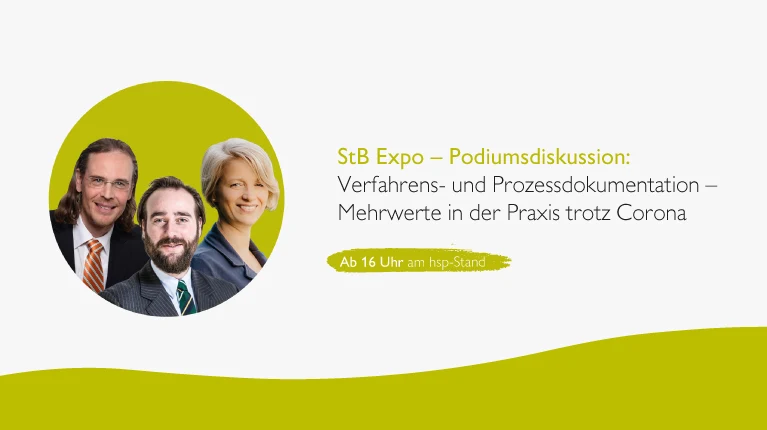
Moderated by hsp Managing Director Paul Liese, tax adviser Mareike Schiersch, tax adviser Armin Schiehser and Dr Christopher Arendt, a specialist solicitor in tax law, discussed digitalisation and the added value of procedural documentation – particularly in light of the current coronavirus pandemic. It is becoming clear that law firms and businesses which have already digitised their work processes are weathering the crisis much more effectively.
Digitalisation was already a topic of discussion at the three law firms represented by the panellists even before the pandemic. Armin Schiehser has already almost fully implemented digitalisation and process documentation for his clients. Mareike Schiersch and Christopher Arendt had not yet reached that stage in the run-up to the crisis; here, the pandemic provided the impetus for a greater focus on this area of work. In the context of tax and business consultancy, the firms are now prioritising process documentation and digitalisation – including within the firms themselves. During the pandemic, a major advantage has become apparent: staff can work flexibly and remotely. This means that work can continue even amidst the restrictions that the crisis has brought about in many places.
Win clients over with procedural documentation
At the outset, however, it is often not at all easy to convince clients of the benefits of digitalisation and procedural documentation. Mareike Schiersch relies on personalised advice, in which she demonstrates to her clients the benefits of such documentation. „In one case, a client was initially very resistant to the idea,“ explains the experienced tax adviser. „However, whilst we were going through the process, he realised: if we do things differently, I’ll have more time to focus on my core business – and, if anything, I’ll make more money too.“
Christopher Arendt takes a rather pragmatic approach here and makes it clear to his clients that procedural documentation, including an internal control system, is simply a legal obligation and not a matter of choice. Only afterwards does he highlight the business benefits that such documentation brings – such as increased efficiency and the avoidance of additional assessments during tax audits.
Armin Schiehser no longer accepts clients who are unwilling to implement digitalisation. As soon as he takes on a client, he draws up a process documentation and says: „For me, this is a matter of principle: How do I optimise a client’s affairs right from the start when taking on the mandate, and how do I make it clear to the client what has been sub-optimal in their operations so far?“ To do this, the tax consultancy must understand the individual processes within the company, know which software is used, and ascertain whether everything is in compliance with GoBD. Whilst this does mean extra work for the tax consultancy and its clients, it is a one-off effort. Subsequently, clients benefit from optimised and automated processes: for example, when accounting data can be automatically reused for the annual accounts and no longer needs to be transferred manually. Or when a tax audit runs smoothly thanks to comprehensive procedural documentation. Schiehser also has a case study to illustrate this: a tax audit at a client’s premises was completed in just three weeks, and the total additional tax payable for four years amounted to a mere 300 euros.
Change in tax practice firms
Providing clients with comprehensive advice is the new focus for tax practice firms. „The profession is undergoing a transformation,“ Christopher Arendt makes clear. „There’s no getting round digitalisation, even within our own firm.“ His firm already has what is known as a ‘future workshop’, where a team is developing a strategy for future, fully digitalised working practices.
Armin Schiehser has also noticed this change: the accounts department in tax practice is getting smaller and smaller, the field of digitalisation consultancy ever-increasing. Law firms must also offer their own staff prospects in this regard: „Staff need a role that will still exist in ten years“ time,” says Armin Schiehser.
Mareike Schiersch agrees with this and makes it clear: „Our clients are delighted with the comprehensive service.“ However, in order to provide this, the firm’s internal processes must also be adapted. Younger staff generally find this easier. New employees no longer necessarily need a background in taxation. „They must be keen to take on the role, think innovatively and be a good fit for the firm,“ says the tax adviser. Armin Schiehser agrees: „We need staff who are IT-savvy and have an understanding of processes.“
Three key elements: process documentation, procedural documentation and tax compliance
Tax compliance will also come to the fore again in future, according to Christopher Arendt: „The hype has died down somewhat over the last two to three years, but it will return,“ namely when the current draft legislation on corporate criminal law comes into force. The primary aim of this legislation is, in fact, to encourage companies to implement a tax compliance management system and thus to monitor themselves. An important side effect is that, if a tax compliance management system is in place, companies can reduce any penalties by half by demonstrating good faith. It is also important for companies to realise that they cannot evade legal liability simply by outsourcing their accounting to a tax consultancy.
As a basis for a Tax Compliance Management System Process documentation is required. This always involves a comparison of target and actual processes. Once the processes have been identified and recorded, the opportunities and risks associated with each individual process can then be identified. „These are individual building blocks,“ explains Armin Schiehser. „First comes the system audit, then the process documentation, then tax compliance.“ „The boundaries between them are fluid, however,“ adds Christopher Arendt.
Advice for aspiring digitalisation consultants
For tax practice firms that also wish to focus more heavily on process and digitalisation consultancy in future, Mareike Schiersch, Armin Schiehser and Christopher Arendt have some essential advice: build up a dedicated team within the practice itself and find the right tool – in other words, a future-proof, established and flexible software solution. Apart from the software, it is now more important than ever to find a partner on the supplier side who not only provides the system but also offers advice and supports tax practices through their initial projects.











 German
  English