


In the History of the hsp There are a number of years that stand out as milestones along our company’s journey. Naturally, the company’s foundation in 1991 is worth mentioning, but so too is 2001, the year of Opti.List or 2008, the year of birth of Opti.Tax, are important milestones on our journey to becoming the industry’s key point of contact and thought leader.
But 2010 also marks a very special milestone: the laying of the foundation stone for our Blog! In this year in review, you can now read about the individual milestones, updates and news that we shared with the world in 2010.
Electronic tax audits: How the tax office carries out its audits
09.02.2010 – Electronic tax audits pursuant to Section 147(5) and (6) of the German Fiscal Code (AO) grant the tax authorities, in the course of an on-site audit, the additional right to examine the taxpayer’s accounts – which have been generated using a data-processing system – by accessing the data. In its online edition, the *Hamburger Abendblatt* presents a seven-point action plan for announced tax audits in an article entitled „When the tax inspector rings the doorbell twice“.
Opti.Mail archives emails in accordance with GDPdU and GoBS standards
18.02.2010 – The Principles of Proper Computerised Accounting Systems (GoBS) provide guidance on the German Commercial Code and the German Fiscal Code with regard to the proper handling of electronic documents. According to the GoBS, emails, as originally digital documents, must also be assigned an unalterable index under which the archived digital document can be processed and managed.
CeBIT: hsp is giving away 100 verification programmes for electronic incoming invoices (GDPdU)
25 February 2010 – The tax office also accepts online invoices for input VAT deduction. There is, however, one restriction: the invoices must bear a digital signature and have been verified electronically by the recipient. Only if all files generated during the verification process are stored in an unalterable format will the tax auditor accept the input tax deduction from electronic invoices.
Opti.List – the complete GDPdU solution – at CeBIT 2010
01.03.2010 – The Principles on Data Access and the Verifiability of Digital Records (GDPdU) set out the requirements for the provision and retention of machine-readable data for external audits by the tax authorities. The compliance specialist hsp, based in Norderstedt, is presenting a comprehensive GDPdU solution at CeBIT covering the areas of data protection, external data archiving, procedural documentation, document archiving and email archiving.
Under Section 147(6) of the German Fiscal Code (AO), the tax authorities have, since 1 January 2002, been granted the right to audit a taxpayer’s accounts—which have been prepared using a data-processing system—by accessing the data. This method of audit complements the option of a conventional audit.
GDPdU Description Standard – not just for the transfer of data media
16.03.2010 – Originally developed to facilitate the transfer of tax-related data to the field auditor’s laptop, the standard for the handover of data media now also plays an important role in data reorganisation and in the transfer of data to archiving systems.
As early as the summer of 2002, the tax authorities developed a standardised technical guideline for describing the format and content of tax-relevant data: the „Description Standard for the Provision of Data Media“. This was done in collaboration with manufacturers of payroll, financial accounting and archiving systems, as well as Audicon, the German distributor of IDEA, the nationally standardised audit software.
Data migration from legacy systems in compliance with the law (GDPdU)
24.03.2010 – Since 2002, new statutory requirements in Germany have had to be observed when changing ERP systems. Alongside the key elements of a migration – such as hardware migration, software implementation and staff training on the new system – one sub-project is of paramount importance: the data migration from the legacy system. But what is the appropriate approach when data needs to be transferred securely and in compliance with the law? How should a data migration be prepared?
Technically speaking, the data migration takes place in two stages. In the first stage, the data from the existing system (legacy system) is converted into a format that the new system can process. To do this, the data is exported from the legacy system and saved as a data migration file in a spreadsheet programme. In the second stage, the data is transferred from the data transfer file into the new system. This is carried out by a data transfer programme, which reads the prepared data and transfers it to the new system. The legacy system can then be taken offline.
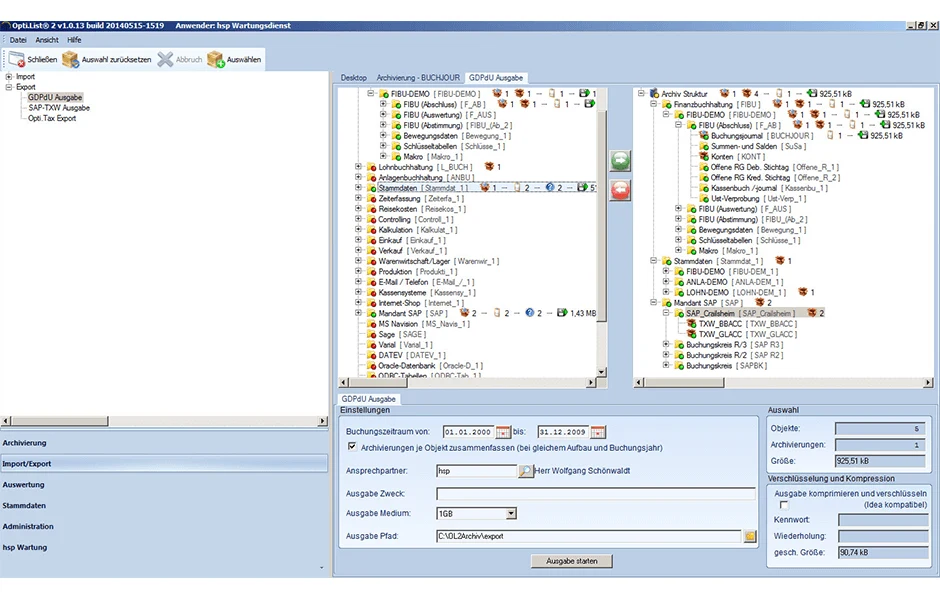
Opti.List – GDPdU Report
Federal Ministry of Finance sets out details of GDPdU late payment penalties
29.03.2010 – In a letter dated 11 March 2010, the Federal Ministry of Finance (BMF) responded to the submission from the DIHK, Berlin, on the subject of provisions for expenses relating to digital tax audits (GDPdU). The German Association of Chambers of Industry and Commerce (DIHK) is the umbrella organisation for the 80 Chambers of Industry and Commerce (IHKs) in Germany. The BMF sees a direct link between provisions for GDPdU expenses and the GDPdU late payment penalty.
The Annual Tax Act 2009 introduced an amendment to the Tax Code that has so far received little attention. Accordingly, it will in future be at the discretion of the tax authorities to impose a late payment penalty of up to EUR 250,000 if the right to access data is not granted.
hsp Software develops GDPdU-compliant email archiving
15 April 2010 – Business processes are increasingly being handled via email. In commercial transactions, emails are treated in the same way as business letters within the meaning of Section 257 of the German Commercial Code (HGB). Emails are therefore subject to the same statutory archiving and retention obligations as all other documents relevant under company and tax law. But how can an email archive be set up to comply with GDPdU requirements?
At this year’s CeBIT, compliance specialist hsp presented Opti.Mail, a GDPdU-compliant email proxy that integrates into the existing email flow and performs specific tasks on the emails passing through it. Opti.Mail therefore operates completely independently of the email server in use. The correct point at which to carry out such processing of emails is downstream of a company’s virus and spam protection.
GDPdU – Tax Audits in Practice
22 April 2010 – Data access grants the tax audit far-reaching rights to inspect data. Companies must allow this access and, in doing so, fulfil comprehensive obligations to cooperate. What can we expect from digital tax audits in future?
GDPdU procedural documentation and transfer pricing documentation
28 April 2010 – For some time now, it has been a requirement to produce written documentation on transfer pricing. This is made considerably easier by using a transfer pricing policy that meets all the requirements*. Above all, this policy contains comprehensive guidelines on pricing. Ensure you remain GDPdU-compliant in this regard too, and make use of the GDPdU procedural documentation with analysis software.
The necessary technical conditions must be put in place to provide quantitative data for price and margin comparisons. This will enable the audit steps to be carried out largely automatically. In practice, establishing the necessary organisational conditions presents a challenge. Taxpayers with businesses above a certain size will be required to document responsibilities and procedures relating to transfer pricing in a written set of working instructions, using procedural documentation.
GDPdU and email management
28 May 2010 – Enquiries, quotations, orders, invoices, contracts and reminders sent by email are increasingly replacing traditional paper-based business correspondence. Data is exchanged, projects are managed, minutes are circulated – emails are part of everyday business life. Managing them efficiently is often a challenge.
Email management is becoming increasingly important across all sectors. Breaches of tax regulations are severely punished: this can result in fines running into five or six figures. Not everyone is aware of this fact.
Provide GDPdU data for the special VAT audit
4 June 2010 – In a letter dated 7 November 2002, the Federal Ministry of Finance (BMF) introduced new regulations governing the conduct of special VAT audits. In addition to setting out the purpose of the audit, the letter contains a detailed description of the criteria used by the tax authorities to select cases for audit. With reference to the newly introduced VAT inspection (Section 27b of the VAT Act), the scope of the audit extends beyond the evidence provided in the accounts and supporting documents. What data must be made available for these types of audit under the GDPdU?
The aim of the special VAT audit is to ensure that taxable supplies are taxed correctly in terms of both substance and timing. The aim is to prevent tax exemptions and tax reliefs from being claimed unduly. The aim is also to prevent input tax from being deducted or refunded without justification.
GDPdU: De-Mail revolutionises payroll accounting
8 June 2010 – As simple as email, as secure as a letter, and as legally binding as a registered letter – that’s the new De-Mail. Secure De-Mail is set to become established in many areas of business. Take payroll, for example: in future, delivering a payslip to an employee via De-Mail will cost no more than 20 cents.
De-Mail is a communication tool designed to enable the secure exchange of legally valid electronic documents between citizens, public authorities and businesses via the internet. De-Mail will be made generally available in the course of 2010. During the current pilot phase, selected areas of application are available for De-Mail.
Processing extracted GDPdU data without an SAP system
17 June 2010 – The SAP Data Retention Tool (SAP DART) allows data to be extracted from SAP solutions and stored on external storage media or a file server. In this way, companies comply with the legal requirement to provide tax-relevant data (GDPdU) to the tax authorities. External software now makes it possible to process these DART extracts further, even without an SAP system.
Opti.List, the comprehensive GDPdU solution, offers additional benefits
24 June 2010 – Opti.List, the tried-and-tested, comprehensive GDPdU solution, offers applications for data archiving, process documentation and email archiving. It enables organisations to meet key compliance requirements. However, numerous integrated functions can also be used independently of their intended purpose.
Input VAT deduction: Required invoice details in accordance with GDPdU
1 July 2010 – In order to claim input tax deduction, the trader must hold an invoice that has been validly issued in accordance with the Value Added Tax Act. An invoice is to be regarded as valid if it contains the mandatory details required by law. According to a ruling by the Federal Fiscal Court, the date of supply must be stated alongside the invoice date.
GDPdU data access to electronic cash registers, scales and taximeters
8 July 2010 – As early as autumn 2009, the tax authorities announced an extension of data access under the GDPdU beyond financial accounting. Phase I is intended to gather the audit services’ experience with the machine-readable analysis of financial and payroll accounting data. The new Stage II is now intended to extend data access to upstream or downstream systems, such as materials management and order management systems. The draft of the BMF circular indicates that there will be changes to the retention of digital records for cash transactions.
Front-end systems for cash transactions store individual data records, which are usually aggregated in financial accounting, for example in daily journals. The process is almost identical for PC-based cash registers, electronic cash registers, scales and taximeters. Until now, redundant data storage has been avoided wherever possible.












 German
  English