


Opti.Tax – Special and supplementary balance sheets
Electronic financial statements for partnerships – Legal basis
Once the ‘no-objection’ rule has expired, from the marketing years which starting after 31 December 2014, the electronic submission of supplementary and special balance sheets is mandatory (see margin note 22 of the Federal Ministry of Finance’s guidance letter of 28 September 2011). Supplementary and special balance sheets must, as a rule, be submitted in a separate data set.
This means that, from the 2015 or 2015/2016 financial year onwards, for each partner (for tax purposes: co-partner) in a partnership (for tax purposes: joint ownership) with a special and/or supplementary balance sheet (S/E balance sheet), there shall be one separate electronic record – in other words, a separate special e-balance sheet or supplementary e-balance sheet – must be prepared. The master data for the S/E balance sheets must be consistent with that of the joint ownership. Tax assessment for the joint ownership will only take place once all the notified data sets – that is, the joint ownership’s e-balance sheet plus the e-balance sheets of the co-owners’ S and E balance sheets – have been received by the tax authorities.
Special and supplementary balance sheets – Solution in Opti.Tax
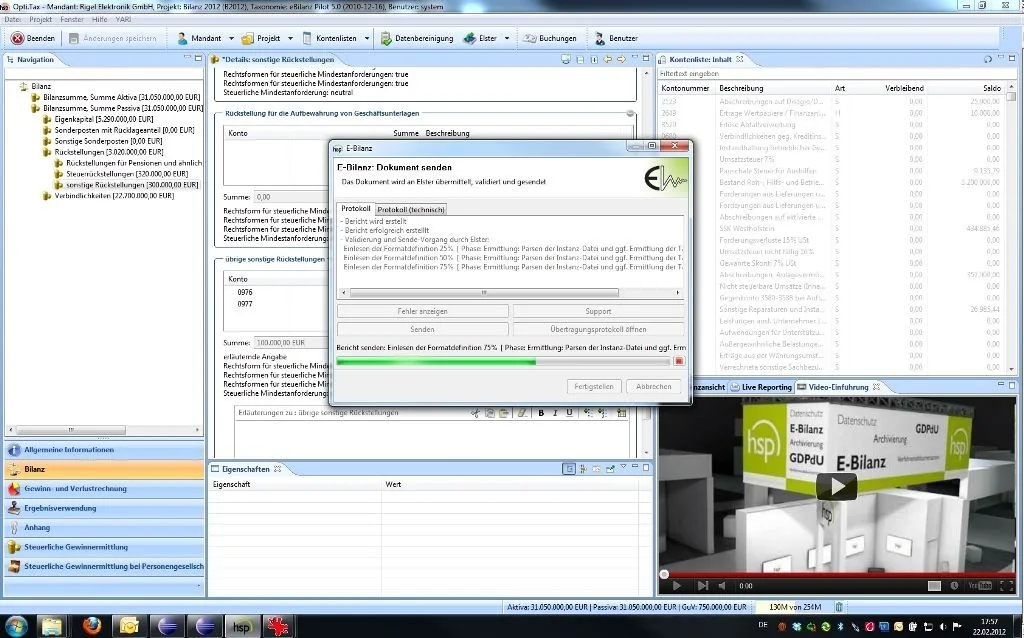
S+E balance sheets – Solution in Opti.Tax
The tax authorities’ requirements necessitate monitoring of all data records sent. The key to successful transmission and error-free processing by the tax authorities is the Consistent reporting of a wide range of master data. To this end, we have developed a specific approach for co-owners covered by the joint ownership regime, which provides a Convenient installation and monitoring of the data records.
With the new module Special and supplementary balance sheets The data records are generated automatically and consistently, eliminating the need to reconcile the partnership’s data with the individual data records of the partners. From our perspective, all the necessary data records are available via Display of processing status and dispatch status listed – No record is ever forgotten.
In the field of Partnerships we have launched our new module, „Special and supplementary balance sheets“has taken a major step towards the monitoring and coordination of complex processes and traceable electronic transmission.”.
Function description
The module „Special and supplementary balance sheets“ enables the automated generation of the announced special and supplementary balance sheets for each shareholder/co-partner. Based on the GCD master record for the joint ownership, the announced individual e-balance sheet projects with master data consistent with the partnership created. These are – apart from the co-owner’s address – no additional master data entries required. However, all master data can also be imported as an Excel list using the module OfficeFiler be imported. This enables the rapid set-up of the Records containing up to 9,999 shareholders possible.
Colour-coded indicators and filters provide a quick visual overview of all partners and the announced (sub-)projects, as well as their current status.
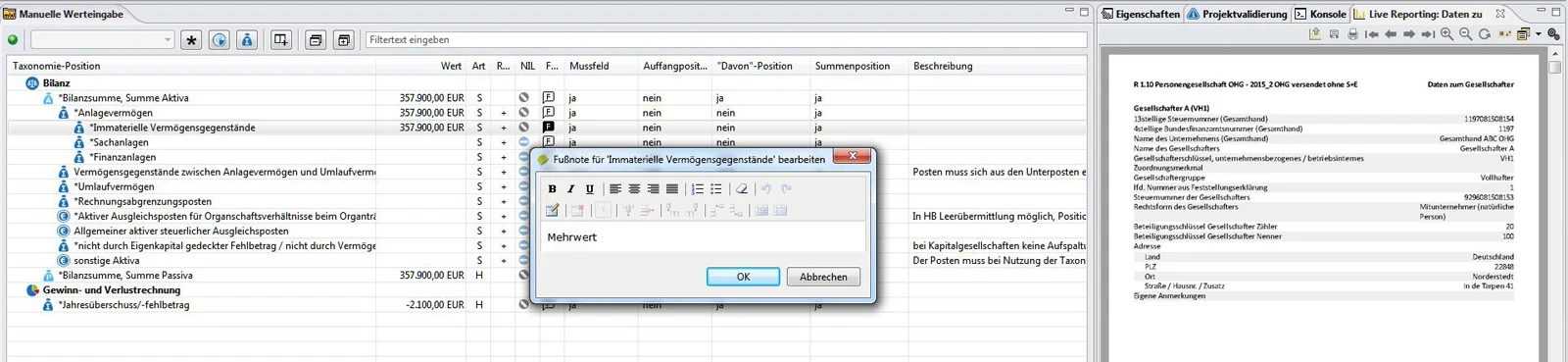
Special and supplementary balance sheets have not been recorded separately to date. As a result, accounting data is generally not available. Accounting is not required in our module either. The Value capture The processes relating to the S+E balance sheet for each co-partner are carried out directly in the taxonomy tree. The option to store Footnotes at each stage ensures that the processes are properly explained. The one required for a valid e-balance sheet project Any further data required for the balance sheet, profit and loss account and other parts of the report are automatically generated by the software. A analogue validation ensures that the announced special and supplementary balance sheets of the co-entrepreneurs are prepared quickly and accurately. The familiar functions – including live reporting and explanations of taxonomy items – form part of the application.
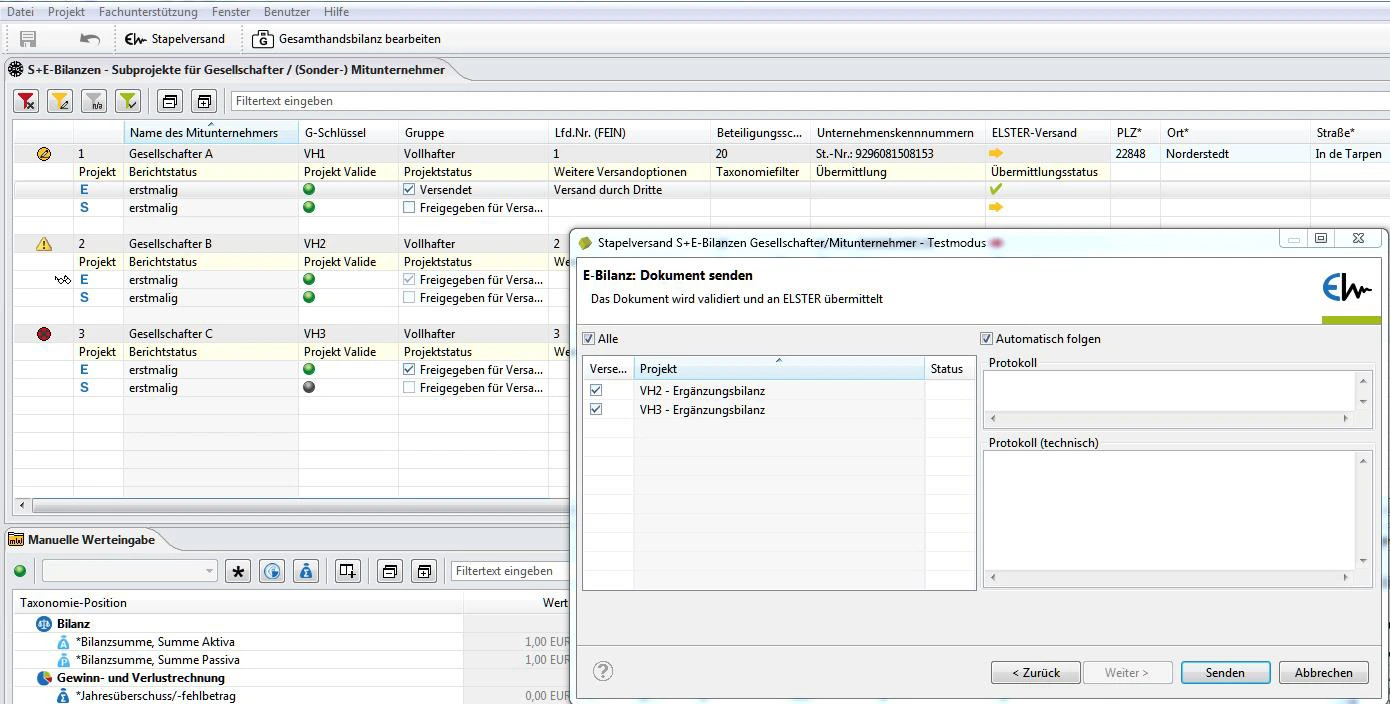
A third-party submission can be flagged, and the ELSTER transmissions are recorded in the overview along with their response messages. This ensures, in the case of joint ownership, a complete overview of all announced special and supplementary balance sheets, including their current processing and dispatch status.
A systematic Bulk dispatch For all recorded S+E (sub)projects, this allows the data to be sent in bulk without having to start each sub-project individually. The entries in the dispatch history are recorded collectively for the entire batch.
With the „Special and supplementary balance sheets“Monitoring and coordinating complex processes and electronic data transmission is simple, convenient, transparent and traceable.”.
The connection to the module OfficeFiler A range of import and export options for Excel and Word – including bulk import of shareholder master data and export of the annual results from the S+E balance sheets for the purposes of tax calculation and reconciliation, as well as for use as an annex to the tax return – round off the solution.
The Special and Supplementary Balance Sheets module consists of:
- Shareholders: Transfer – Conflict Dialogue
- S/E perspective
- S/E value recording
- S/E properties
- S/E Live Validation
- S/E Live Reporting
- S/E Bulk Postage
- Interface to the module OfficeFiler
More screenshots:
What are supplementary balance sheets?
Supplementary balance sheets are additional balance sheets that may be drawn up alongside the main balance sheet to provide further information about the company. Supplementary balance sheets can take various forms and contain different information depending on the company’s needs.
One common type of supplementary financial statements is segment reports, which break down the company’s financial data by business segment or geographical region. This enables investors and other stakeholders to better understand how the company operates in different areas and what risks and opportunities are associated with each segment.
Another type of supplementary balance sheet is a pro forma balance sheet, which sets out alternative scenarios showing how the company would perform if certain events were to occur. For example, a pro forma balance sheet might be drawn up to show how a merger or takeover would affect the company.
Overall, supplementary balance sheets can be a useful tool for providing additional information about the company and giving stakeholders a more comprehensive view of the company’s finances and business strategy.
What is a special e-balance sheet?
A special E-Balance Sheet is a specific type of balance sheet that can be drawn up as part of the E-Balance Sheet submission to the tax office. It is used to reflect specific business transactions or circumstances that cannot be shown in the standard balance sheet.
Examples of such special e-balance sheets include the opening balance sheet (when a company is formed), the closing balance sheet (when a company is wound up), interim balance sheets (in the event of changes during the financial year), balance sheets showing carried-forward losses and profits, and liquidation balance sheets.
By preparing special e-balance sheets, companies can ensure that they comply with tax regulations and statutory accounting requirements. The e-balance sheet is submitted to the tax office electronically, thereby replacing the paper-based submission of tax returns that was previously the norm.












 German
  English